

Married life demands precise religious understanding, particularly concerning Thaharah (purification) from major ritual impurity (hadath al-akbar). A servant’s prayers and recitation of the Qur’an are legally invalid if they have not performed the major obligatory bath (Ghusl) when required. Therefore, attaining a deep understanding of purification is crucial for every Muslim. One private matter that frequently sparks doubt among married couples is the exact boundary of physical contact that necessitates this bath. Common questions include, “Does intercourse require Ghusl if it was only slight?” or “Is the bath obligatory if ejaculation did not occur?”
To answer these concerns with sound knowledge, we must analyze authoritative Shafi’i jurisprudence. We refer to the text of Asna al-Matalib Sharh Rawdh ath-Thalib (Volume 1, Page 64) by the eminent scholar Shaykhul Islam Zakariyya al-Anṣārī.
The Legal Boundary of Marital Intercourse Requiring Ghusl
In classical Fiqh literature, the causes of Janabah (the state of major impurity) are several. A primary cause is sexual intercourse, termed Jima’ or intercourse requiring Ghusl. Islamic law establishes a very clear standard regarding the legal threshold of intercourse that obligates married couples to perform the bath, known by the jurisprudential term Iltiqa’ al-Khitanain (the meeting of the two circumcised parts).
Shaykhul Islam Zakariyya al-Ansari details the meaning of this “meeting”:
وليس المراد بالتقاء الختانين انضمامهما لعدم إيجابه الغسل بالإجماع بل تحاذيهما يقال التقى الفارسان إذا تحاذيا وإن لم ينضما وذلك إنما يحصل بإدخال الحشفة في الفرج
“And what is meant by the meeting of the two circumcised parts is not their joining together (mere external contact), because mere joining does not necessitate a bath by scholarly consensus (ijma’). Rather, its meaning is their parallel positioning or passing each other (tahadzi). The Arabs say, ‘The two horsemen met (iltaqa)’ when their positions pass parallel to each other, even if their bodies do not touch. And that parallelism only occurs by inserting the hashafah (the glans/head of the penis) into the farj (vaginal cavity).”
This explanation highlights that superficial physical contact on the outside of the genitalia does not cause an obligation for either the husband or wife to perform the major bath, provided there is no emission of seminal fluid. Possessing this understanding is vital so that one does not easily fall prey to waswasa (misgivings) regarding the causes necessitating Ghusl in Shafi’i Fiqh.
Does Slight Penetration Necessitate Ghusl? A Fiqh Analysis
Addressing the common inquiry, “Does slight penetration intercourse require Ghusl?”, we must measure the phrase “slight” against the anatomical parameter established by the Fuqaha (jurists): the Hashafah (glans penis).
What is the ruling if only a small portion of the glans enters, not yet passing the total boundary of the hashafah? The text of Asna al-Matalib provides a reassuring and distinct legal ruling:
قوله: (و) إدخال (دون الحشفة ملغى) فلا يوجب شيئا من أحكام الجماع لما علم مما مر
“And the insertion of less than the hashafah (duna al-hasyafah) is nullified (mulgha); therefore, it does not necessitate any of the legal rulings of jima’ (intercourse) based on what has already been established from the previous explanation.”
The term mulgha (nullified/disregarded) implies that penetration less than the measure of the hashafah is not legally recognized as Jima’ (intercourse) in Shari’ah. Consequently, if penetration truly only occurred at the very outer tip (the entire hashafah was not submerged), the obligation for Ghusl has not yet fallen upon the couple. This applies with the condition that no semen is discharged or emitted afterward.
Penetration Without Ejaculation: Does This Intercourse Require Ghusl?
A second doubt arises in a different situation. What if the glans (hashafah) has entered completely, passing the boundary of the farj, but the couple ceases activity before climax? Does this scenario of complete penetration but no discharge still mean that intercourse require Ghusl?
In this scenario, Islamic legal ruling is definitive. When the hashafah is fully submerged internally, the state of Janabah immediately applies to both parties at that very moment. Shaykhul Islam Zakariyya al-Anṣārī bases this ruling on an authentic hadith narration found in Sahih al-Bukhari and Sahih Muslim:
الأول بإدخال حشفة … لخبر الصحيحين «إذا التقى الختانان فقد وجب الغسل» وفي رواية لمسلم: وإن لم ينزل
“The first cause [of Janabah] is by inserting the hashafah… based on the narration of the two Sahih [Bukhari and Muslim]: ‘If the two circumcised parts meet, then Ghusl has become obligatory.’ And in a narration by Muslim, there is an additional phrase: ‘Even if he does not ejaculate’ (wa in lam yunzil).”
The phrase wa in lam yunzil resolves all doubt. Even if the husband or wife feels no pleasure whatsoever and seminal fluid is not emitted, the obligation for the major bath is binding upon them. This is because the Shari’ah threshold (‘illah) for the obligatory bath in the context of sexual relations is penetration of the hashafah, not ejaculation. Within Fiqh, penetration and emission are two separate and independent causes for requiring the bath.
Considering the paramount importance of the validity of this bath for daily worship, every Muslim is advised to study a complete guide to the procedures of the major obligatory bath (Ghusl) according to the Shafi’i school to ensure their purification is perfect.
Summary Table: Intercourse Thresholds and Ghusl Obligations
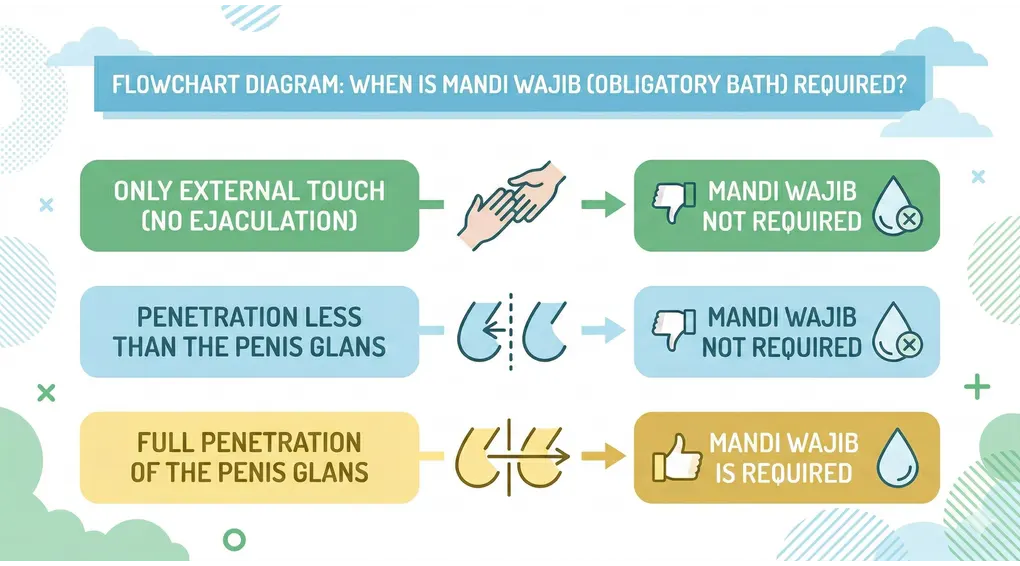
To ensure this Fiqh understanding is easily remembered, please consult the following legal classification table:
| Physical Contact Condition (Penetration) | Fluid Emission Condition | Legal Status of Couple |
| External contact/friction | No semen emission | Not yet in Janabah (Only invalidates Wudu) |
| Entered less than the boundary of the Hashafah | No semen emission | Not yet in Janabah (Only invalidates Wudu) |
| Entered completely beyond the Hashafah boundary | No semen emission | GHUSL OBLIGATORY (Janabah applied) |
| Physical contact of any kind | Semen emitted | GHUSL OBLIGATORY (Janabah applied) |
FAQ: Common Fiqh Questions on Intercourse and Purification
If a couple only touches superficially externally and only madzi is emitted, is Ghusl obligatory?
No. Superficial external contact that is not accompanied by the emission of seminal fluid (mani) does not necessitate the major bath. Madzi fluid (a thin, clear, sticky fluid emitted at the beginning of arousal) is legally classified as najis (impurity) that only invalidates Wudu. You only need to wash the area affected by madzi and perform Wudu again. For a deeper understanding, read the detailed differences between Mani and Madzi.
If half of the glans penis enters and is then withdrawn, is Ghusl required?
Based on the legal text (دون الحشفة ملغى), if the part that entered was truly less than the total boundary of the hashafah (only the tip or half) and was then withdrawn, that action is legally disregarded (mulgha) in Shafi’i Fiqh. The couple is not required to take the major bath, provided that no seminal fluid is emitted afterward.
If the husband uses a barrier like a thick condom so there is no direct skin contact, and no semen is emitted into the farj, does the wife still require Ghusl?
Yes, both must still perform Ghusl. The text of Asna al-Matalib mentions that the entry of the hashafah using a barrier (ha’il) such as a thick cloth (khurqah ghalizhah) still necessitates the bath for both parties, even if seminal fluid does not emit at all. Islamic jurisprudence does not distinguish between the use of prophylactics or otherwise in this specific ruling. You may read a detailed review regarding Ghusl after intercourse using a condom or barrier to deepen your understanding of this issue.
Conclusion
The threshold of sexual intercourse require Ghusl in the Shafi’i school is precisely defined. It is the full insertion of the hashafah (glans penis) into the female genital cavity, regardless of whether ejaculation occurs or a barrier is used. Understanding these specific juristic boundaries is essential for maintaining ritual purity and the validity of obligatory worship. By adhering to these established guidelines, a Muslim married couple can ensure their spiritual well-being while navigating their private lives with religious confidence.
Wallahu a’lam bish-shawab (And Allah knows best).
Conceptual References
Zakariyyā al-Anṣārī, Asnā al-Maṭālib fī Sharḥ Rawḍ al-Ṭālib, with the ḥāshiyah of Aḥmad al-Ramlī, edited by Muḥammad az-Zuhrī al-Ghamrāwī (Cairo: al-Maṭbaʿah al-Maymānīyah, 1313 AH; repr. Dār al-Kitāb al-Islāmī), vol. 1, pp. 64-65.


