

The issue of providing a salary or financial compensation for a muezzin (the one who calls to prayer) frequently becomes a heated topic during mosque committee (DKM) meetings. On one hand, there is a strong desire to have someone who performs the adhan sincerely, seeking only the pleasure of Allah. On the other hand, a muezzin is required to maintain strict temporal discipline five times a day—a heavy responsibility that consumes their productive time otherwise spent earning a livelihood.
So, what is the actual scholarly perspective on this matter? Does giving an envelope or a stipend to the caller to prayer tarnish the spiritual value of the worship?
We will directly examine the authoritative references from the book Asna al-Matalib by Shaykh al-Islam Zakariyya al-Ansari, a prominent scholar of the Shafi’i school. This classical text provides detailed and highly relevant guidelines for modern mosque management, specifically addressing the intricacies of paying a muezzin.
The Original Ruling: Volunteering is Superior
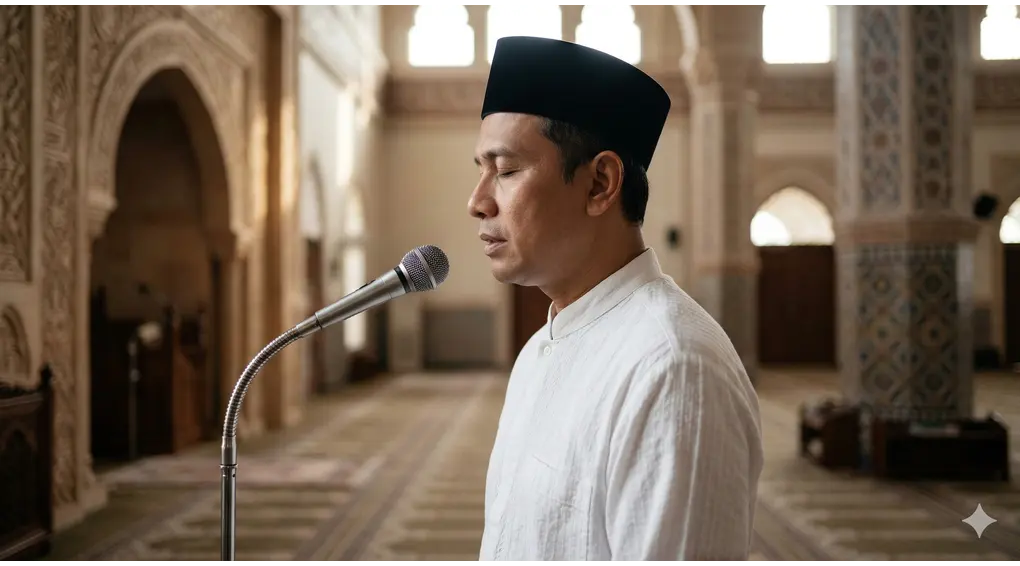
In Islam, the foundational principle of becoming a muezzin is voluntary service. It is an exceptionally noble position. The Prophet Muhammad ﷺ promised extraordinary rewards for those who call the adhan without demanding material compensation. For this reason, understanding the valid conditions to become a muezzin is crucial before assigning the role.
Let us examine the original text from Asna al-Matalib:
فرع ويستحب: للمؤذن (أن يتطوع به) أي بالأذان لخبر «من أذن سبع سنين محتسبا كتبت له براءة من النار» رواه الترمذي وغيره
Translation: “Branch Issue: It is recommended for the muezzin (to volunteer for it), meaning the adhan, based on the hadith: ‘Whoever calls the adhan for seven years seeking reward (muhtasiban), a decree of safety from the Fire is written for him.’ (Narrated by At-Tirmidhi and others).”
This point is unequivocal. If there is a capable community member with a loud voice who is willing to perform the adhan for free purely for the sake of Allah, that is the most ideal condition. The mosque committee does not need to worry about allocating a budget, and the muezzin receives a guarantee of immense divine reward. This perfectly aligns with the core concept of faith in Allah, where actions are driven by divine pleasure rather than worldly gain.
The Mosque Treasury Dilemma: When is Paying a Muezzin Permissible?
Managing mosque funds requires a profound level of caution, akin to safeguarding the wealth of orphans. This illustration depicts the heavy considerations faced by mosque committees: when is the appropriate time to disburse community funds for paying a muezzin, and when must they be withheld for the sake of efficiency?
The problem arises when no one is willing to perform the adhan regularly, or when those who are willing are frequently absent. This is where fiqh intervenes to provide realistic solutions. The government or mosque administrators are permitted to disburse funds to pay a muezzin, but strict conditions apply.
Shaykh Zakariyya al-Ansari explains:
فإن أبي رزقه الإمام من مال المصالح كما صرح به الأصل قال في المجموع قال أصحابنا ولا يجوز أن يرزق مؤذنا وهو يجد متبرعا عدلا كما نص عليه قال القاضي حسين لأن الإمام في مال بيت المال كالوصي في مال اليتيم والوصي لو وجد من يعمل في مال اليتيم متبرعا لم يجز أن يستأجر عليه من مال اليتيم فكذا الإمام
Translation: “If they refuse, the Imam (leader/administrator) may provide for him from the funds of public interest (mal al-masalih), as stated in the original text. He said in Al-Majmu’: Our companions said it is not permissible to provide for a muezzin when he finds a trustworthy volunteer (mutabarri’an ‘adlan), as explicitly stated. Qadhi Husayn said: Because the Imam’s position regarding the public treasury (Bayt al-Mal) is like that of a guardian over an orphan’s wealth. If the guardian finds someone willing to work for the orphan’s wealth voluntarily, it is not permissible for him to hire someone using the orphan’s wealth; thus is the case for the Imam.”
The reasoning is highly logical and touches upon the aspect of financial trust (amanah). The position of the administrator regarding the mosque’s treasury is akin to a guardian holding an orphan’s money. If free services can be secured, it is legally forbidden (haram) to squander the orphan’s money (community funds) to pay someone else. Financial conservation of community funds is the absolute priority.
Unique Cases: Choosing Between a Transgressor and a Golden Voice
What if the person willing to perform the adhan for free is a transgressor (fasiq—someone who commits sins or cannot be trusted), while a trustworthy person demands a salary? Or, what if the volunteer has an ordinary voice, whereas the one demanding a salary has an exceptionally melodious voice that touches the heart?
The text answers this dilemma meticulously:
(فإن تطوع به فاسق وثم أمين أو أمين وثم أمين أحسن صوتا منه (وأبى الأمين) في الأولى (وكذا الأحسن صوتا) في الثانية (إلا بالرزق رزقه الإمام من سهم المصالح) عند حاجته بقدرها
Translation: “(If a transgressor volunteers for it, and there is a trustworthy person available; or if a trustworthy person volunteers, and there is another trustworthy person with a more beautiful voice), (and the trustworthy person refuses) in the first scenario, (and likewise the one with the more beautiful voice) in the second scenario, (except with a provision, the Imam shall provide for him from the share of public interest)” according to his need, to the extent of it.
In this specific situation, the public benefit (maslahah) of Islamic propagation (syi’ar) takes precedence. If the trustworthy person (amin) or the one with the superior voice refuses to call the adhan unless paid, then the mosque administrators are permitted to pay them.
Why? Because a beautiful voice and a trustworthy muezzin will attract the hearts of the congregation to attend the mosque. This is an investment in da’wah (Islamic propagation). The salary is drawn from the public interest fund corresponding to the basic needs of that muezzin. Therefore, it is not for luxurious living, but merely for sufficiency (kifayah). This highlights the importance of understanding the meaning and history of Adhan and Iqamah to appreciate its profound impact on the community.
Priority of Fund Allocation for Muezzins
If the mosque treasury is severely limited, who must be prioritized? Shafi’i fiqh possesses an intelligent priority sequence based on social impact.
- The Muezzin of the Grand Mosque (Jami’): This is the top priority because it serves as the largest gathering center for the ummah.
- The Friday Prayer Adhan: Because the Friday prayer is a weekly communal obligation involving the masses.
The original text states:
ويبدأ وجوبا إن ضاق بيت المال وندبا إن اتسع (بالأهم كمؤذن الجامع) … (وأذان الخطبة) الأولى قول أصله وأذان صلاة الجمعة (أهم) من غيره
Translation: “And he must begin obligatorily if the public treasury is tight, and recommendedly if it is abundant, (with the most important, such as the muezzin of the Grand Mosque)… (and the adhan of the sermon) the first [adhan], which is the original statement, and the adhan of the Friday prayer (is more important) than others.”
This teaches us profound budget management. If cash reserves are depleting, secure the operational funds first for the activities involving the largest mass of people.
Rules of the Employment Contract (Ijarah) for a Muezzin
Confusion often arises regarding the employment status of a muezzin. Are they considered employees?
In the perspective of fiqh, the adhan is a task whose benefits are felt by the public, similar to teaching the Qur’an. Therefore, establishing a service lease contract (ijarah) is entirely permissible. This requires a clear understanding of intention (niyat) from both parties regarding the nature of the work.
ولكل من الإمام وغيره (استئجاره) على الأذان لأنه عمل معلوم يرزق عليه ككتابة الصك
Translation: “And it is permissible for the Imam and others (to hire him) for the adhan because it is a known work for which one is provided, like writing a deed.”
There is a distinct regulatory difference between the government (Baitul Mal) and private entities (Foundations/Individuals) when recruiting a muezzin:
- Government/State: Permitted to recruit without a specific time limit. It is sufficient to say, “I will pay you this amount per month.” This is due to the continuous operational nature of the state.
- Private/Individual: It is obligatory to determine a clear contract duration. For example, “I contract you to perform the adhan for one year.” This is crucial to ensure the contract is valid and no party is harmed by uncertainty (gharar) in the future.
Do Not Separate the Iqamah from the Adhan!
This is a point frequently overlooked. The iqamah is a packaged deal with the adhan. You cannot create a specific employment contract solely for a person who performs the iqamah.
وتدخل الإقامة في الاستئجار للأذان (ضمنا فيبطل إفرادها بإجارة) إذ لا كلفة فيها وفي الأذان كلفة لرعاية الوقت
Translation: “And the iqamah is included in the hiring for the adhan (implicitly, thus singling it out for a lease is invalid) since there is no hardship in it, whereas in the adhan there is the hardship of monitoring the time.”
Why can’t the iqamah be contracted separately? Because the iqamah is light; there is no heavy burden attached to it. This differs significantly from the adhan, which carries the heavy responsibility of continuously monitoring the entry of prayer times (muraqabatul waqt). The muezzin must be on “standby” observing the sun or the schedule—that is precisely what is being paid for. The iqamah merely follows the command of the Imam or the presence of the congregation, so it is automatically included in the muezzin’s duties.
Practical Application for Mosque Committees
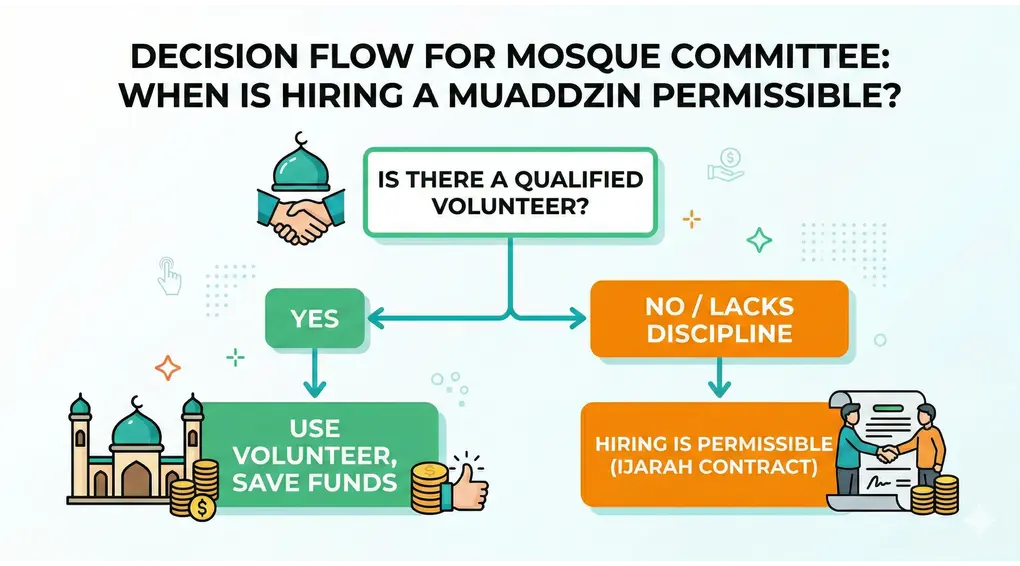
Based on the explanations from the book Asna al-Matalib above, mosque committees (takmir) can take several practical steps regarding paying a muezzin:
- Seek Volunteers First: Open opportunities for community members who wish to perform the adhan voluntarily. This conserves the mosque treasury.
- Value Quality: If you desire a prosperous mosque and a stronger Islamic atmosphere (syi’ar), do not hesitate to allocate a budget to recruit a muezzin with a beautiful voice and strict discipline. That is not wasteful; it is a strategic da’wah investment.
- Contract Transparency: Create a clear employment agreement. Determine the term of service (e.g., evaluated annually) and the nominal stipend (bisyaroh), to comply with the conditions of a non-governmental ijarah contract.
- Focus on the Primary Muezzin: Ensure the muezzin holds the true responsibility of tracking prayer times, not merely showing up to perform the iqamah.
Conclusion
Understanding the fiqh of the muezzin makes us significantly wiser in mosque administration. We are no longer rigidly forbidding salaries in the absolute name of sincerity, yet we also do not carelessly squander the ummah’s money if there is potential for capable volunteers. This precise balance is the profound wisdom taught by our classical scholars.
FAQ: Questions About Muezzin Compensation
Is it permissible for a mosque committee to pay a muezzin if there are volunteers available?
According to Shafi’i fiqh, it is generally forbidden to pay a muezzin using mosque funds if there is a trustworthy and capable volunteer willing to do it for free. The exception is if the volunteer is untrustworthy (fasiq) or has a poor voice, and a paid muezzin with a beautiful voice is needed to attract the congregation.
Can a mosque hire someone specifically just to call the Iqamah?
No. The fiqh explicitly states that the iqamah is implicitly included in the duties of the adhan. It is invalid to create a separate financial contract solely for calling the iqamah because it lacks the burden of monitoring prayer times.
What type of contract should a private mosque use when paying a muezzin?
A private mosque must use a specific lease/service contract (ijarah) that clearly defines the duration of the employment (e.g., one year) and the exact compensation. This prevents uncertainty (gharar) and ensures the rights of both the mosque and the muezzin are protected.
Reference
Zakariyā al-Anṣārī, Asnā al-Maṭālib fī Sharḥ Rawḍ al-Ṭālib, with the ḥāshiyah by Aḥmad al-Ramlī, edited by Muḥammad az-Zuhrī al-Ghamrāwī (Cairo: al-Maṭbaʿah al-Maymānīyah, 1313 H; repr. Dār al-Kitāb al-Islāmī), vol. 1, pp. 131-132.


