
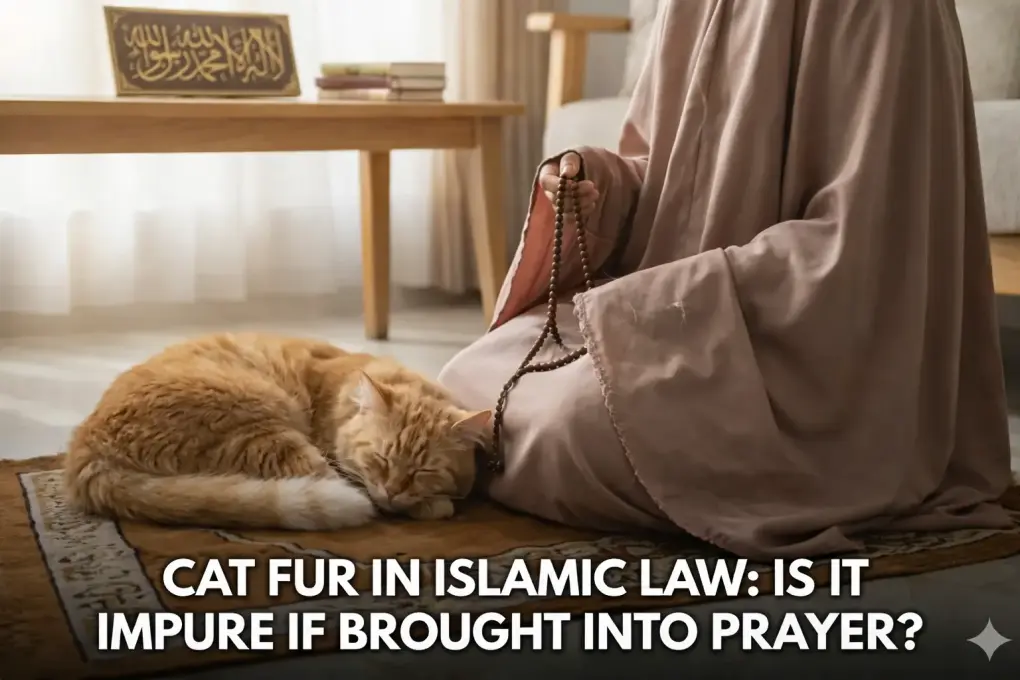
For cat lovers or “paw parents,” playing with beloved pets is a moment of immense joy. However, there is one classic problem that frequently causes concern: shedding hair everywhere. You find it on the sofa, the bed, and often clinging to the clothes you intend to wear for worship.
This condition naturally raises a significant question in our minds. What exactly is the Islamic ruling on cat hair? Does our prayer remain valid if one or two strands of fur are attached to our trousers or prayer garments?
To address these doubts academically, we must revisit classical jurisprudential texts. We will examine the foundational rulings from the book Asna al-Matalib and explore the dispensations provided in Hasyiyah al-Bujairimi. Let us thoroughly discuss this matter so your heart finds tranquility when facing the Creator.
Understanding the Core Principle: Severed Animal Parts
Before passing a definitive judgment on whether cat hair is pure or impure, we must understand the primary jurisprudential maxim (qaidah) upheld by Shafi’i scholars. This maxim governs the purity status of body parts that become detached from an animal while it is still alive.
In the book Asna al-Matalib (Volume 1, page 11), Shaykh Zakariyya al-Anshari articulates this foundational principle:
فرع : الفرع ما اندرج تحت أصل كلي الجزء ( المبان من حي , ومشيمته ) … ( كميتته ) أي كميتة ذلك الحي طهارة , ونجاسة لخبر « ما قطع من حي فهو ميت » رواه الحاكم
Meaning: “A detached part from a living animal… its ruling is like its carcass, both in terms of purity and impurity, based on the hadith: ‘Whatever is cut off from a living animal, then it is a carcass’.”
This is the primary formula for understanding the concept of najis regarding animal parts. If a body part (including hair or skin) detaches from a living animal, we evaluate its status based on what the animal would be considered if it died and became a carcass:
- If its carcass is pure (such as humans, fish, and locusts), then its detached parts during life are also pure.
- If its carcass is impure (such as cows, goats, and cats), then its detached parts during life are fundamentally impure (najis).
How does this apply to cats? We know that if a cat dies without being ritually slaughtered (and indeed, cats are not ritually slaughtered), it becomes an impure carcass. Based on this logic, the ruling on shed cat hair dictates that it is impure because it is part of an animal whose carcass is impure.
The Exception for Halal Animals (Ma’kul al-Lahm)
Do not panic just yet; Islamic law (syariat) is not rigidly burdensome. The text Asna al-Matalib provides explicit exceptions for specific types of animals regarding the ruling on animal hair.
قوله : ( لا شعر مأكول , وريشه ) فطاهران ( ولو انتتف ) كل منهما أو نتف , وما في معناهما من صوف , ووبر قال تعالى { ومن أصوافها وأوبارها وأشعارها أثاثا ومتاعا إلى حين 1}
Meaning: “(Except the hair of an animal whose meat is lawful to eat, and its feathers), then both are pure (even if they fall out naturally) or are plucked… based on the word of Allah: ‘…and from their wool, fur, and hair… [QS. An-Nahl: 80]’.”
Therefore, sheep’s wool, chicken feathers, or cow hair that sheds while the animal is alive is classified as PURE. This is a specific dispensation for halal livestock (ma’kul al-lahm).
The issue is that a cat is not a halal livestock animal. Cats possess fangs and are unlawful to consume. Because cats do not fall under the exception of “animals whose meat is eaten,” the status of their hair reverts to the default ruling: Najis.
The Fiqh Solution: Excused Impurities (Ma’fu ‘Anhu)
If we stopped reading there, it would be extremely difficult for cat owners. It is nearly impossible to keep a house 100% free of cat hair. This is where the vast mercy within Shafi’i fiqh becomes evident.
Although the physical substance of cat hair is technically najis (because it separates from an animal whose meat cannot be eaten), scholars provide tolerance. This is reinforced in another authoritative reference, Hasyiyah al-Bujairimi ‘ala Syarh al-Manhaj.
The text presents a highly reassuring rule:
قوله : ( فنجس ) ويعفى عن يسيره من غير نحو كلب وعن كثيره من مركوبه . اه ـ. ح ل 2
Meaning: “His statement: (then it is impure), however, a small amount of it is excused—from animals other than dogs [and pigs]—and a large amount is excused from riding animals.” (Hasyiyah al-Bujairimi ‘ala Syarh al-Manhaj)
This reference is a crucial key to ensuring the validity conditions of prayer are met without undue hardship. The condition of being “excused” (ma’fu) applies under these stipulations:
- Not Dogs and Pigs: Cats are considered ritually pure animals while alive (they are not najis mughalladzah), so their shed hair receives this dispensation.
- A Small Amount (Yasir): If the attached hair is only one, two, or three strands, this is considered a small amount according to general custom (‘urf) and is excused. Your prayer remains valid.
Therefore, regarding the Islamic ruling on cat hair carried into prayer, if the amount is minimal and difficult to avoid, there is no need for anxiety (was-was). The impurity is pardoned by the syariat.
What Should You Do in Case of Doubt?
Often, we spot a fiber on our clothing but are unsure if it is cat hair, a stray thread, or fuzz from our own wool jacket. In states of uncertainty, Asna al-Matalib offers guidance:
قوله : ( ولا مشكوك فيه ) أي في أن الشعر , ونحوه من مأكول أو غيره لأن الأصل الطهارة
Meaning: “(And neither is [impure] something that is doubted), meaning a doubt whether the hair comes from a halal animal or not, because the original ruling is purity.”
If you are in doubt, return to the default ruling: Pure. Doubt cannot overrule certainty. You are not required to inspect every inch of fabric with a magnifying glass before establishing the concept of prayer.
Practical Tips for Cat Owners During Worship
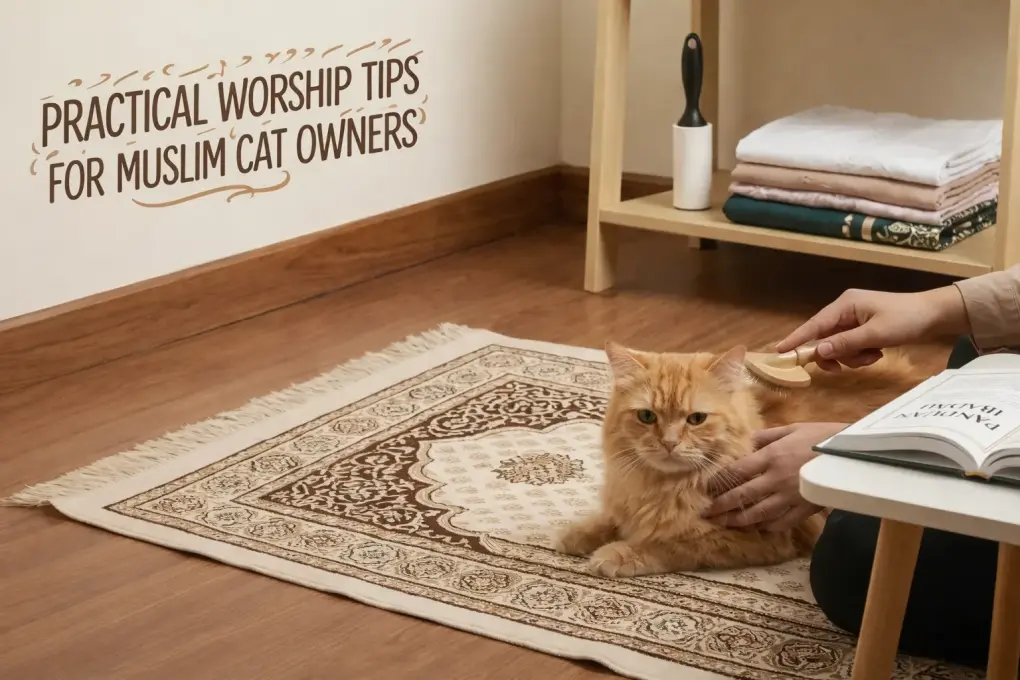
Here are several practical steps to ensure your worship remains peaceful and valid:
- Prepare Dedicated Prayer Clothes: Try to have one set of clothes (sarong, shirt, or mukena) specifically reserved for prayer. Store them in a closed wardrobe out of your cat’s reach.
- Use a Clean Prayer Mat: Do not leave your prayer mat spread on the floor permanently, as cats love to sleep on them. Fold the mat immediately after concluding your prayer to prevent shed hair from accumulating.
- Keep a Lint Roller Handy: A lint roller is a cat owner’s best friend. Before praying, take a brief moment to clean your knee area or clothing. This is a form of proactive effort (ikhtiar) to maintain cleanliness.
- Maintain the Cat’s Hygiene: Routinely brushing and occasionally bathing your cat will significantly reduce shedding, lowering the risk of accumulating an unexcused amount of fur.
Conclusion
When addressing the Islamic ruling on cat hair carried into prayer, the answer is nuanced rather than rigidly punitive.
Substantially, shed cat hair is judged as najis in the Shafi’i madhhab because it separates from an animal whose meat is not consumed. However, based on the authoritative explanations in Hasyiyah al-Bujairimi, this specific impurity falls into the category of ma’fu ‘anhu (excused) if the quantity is small.
The core takeaway is that the presence of a cat should not make your worship feel burdensome. Islam facilitates ease. Maintain cleanliness to the best of your ability, remove visibly accumulated hair, and if a few unavoidable strands remain, your prayer, God willing, remains valid.
Frequently Asked Questions (FAQ)
1. Is my prayer valid if there is cat hair on my clothes?
Yes, your prayer is perfectly valid if the amount of cat hair on your clothing is minimal (e.g., one to three strands). While technically najis according to the Shafi’i school, a small, unavoidable amount is legally excused (ma’fu ‘anhu).
2. Does cat saliva have the same ruling as cat hair?
No. Unlike detached hair, a living cat itself is considered ritually pure. Therefore, its saliva is pure. If a cat licks your hand or clothing, you are not required to wash the area before praying.
3. How much cat hair is considered “a small amount” (yasir)?
In Islamic jurisprudence, “a small amount” is generally determined by local custom (‘urf). Most scholars suggest that one to three strands easily fall under this category. If the hair is so abundant that it is glaringly obvious from a distance and covers a significant portion of the clothing, it is considered a large amount and must be removed before prayer.
References
- Zakariyā al-Anṣārī, Asnā al-Maṭālib fī Sharḥ Rawḍ al-Ṭālib, dengan ḥāshiyah oleh Aḥmad al-Ramlī, disunting oleh Muḥammad az-Zuhrī al-Ghamrāwī (Kairo: al-Maṭbaʿah al-Maymānīyah, 1313 H; repr. Dār al-Kitāb al-Islāmī), juz 1, hlm. 11. ↩︎
- Sulaimān bin Muḥammad bin ‘Umar al-Bujayrimī, al-Tajrīd li Naf‘ al-‘Abīd (Ḥāshiyah al-Bujayrimī ‘alā Syarḥ al-Manhaj) (Kairo: Maṭba‘ah al-Ḥalabī, tanpa cetakan, 1369 H/1950 M), jil. 1, hlm. 102. ↩︎


