

Have you ever found yourself trapped in an incredibly awkward situation like this? You are sitting casually with friends or colleagues. Initially, the conversation flows pleasantly, discussing hobbies or work. Suddenly, the direction of the conversation shifts. One person begins mentioning someone’s name, and slowly, they start “peeling away” their flaws and exposing their private faults.
The atmosphere becomes intensely uncomfortable for your heart, yet thrilling for the others. You remain utterly silent because you feel “awkward” or overly polite to interrupt the conversation. You rationalize to yourself, “Well, the important thing is that I am not the one speaking; I am just listening.”
Hold on. Do you realize that in Islam, the position of the listener to gossip is just as spiritually perilous as the speaker?
Many of us simply do not know how to deal with backbiting (ghibah) correctly according to the Sharia. We frequently find ourselves trapped between preserving a friend’s feelings and upholding God’s boundaries. This article will comprehensively discuss the proper attitude when friends gossip, based on the authoritative guidance of Imam Al-Ghazali in his monumental work Ihya’ ‘Ulum al-Din, ensuring we are not dragged into this collective sin.
To ensure you have a firm grasp of the fundamental definitions before we proceed, you can read our detailed breakdown on what ghibah actually is.
The Danger of Being a Loyal Listener to Backbiting

Before diving into practical tips, we must fundamentally alter our mindset. The majority of people feel spiritually safe as long as their own tongue is not moving. In reality, ears that actively enjoy hearing the flaws of others are conduits of sin just as heavily flowing as the tongue.
Imam Al-Ghazali issues a severe warning: Remaining silent while hearing backbiting equates to active consent. In a profound hadith, the Messenger of Allah ﷺ stated:
الْمُسْتَمِعُ أَحَدُ الْمُغْتَابَيْنِ
“The listener is one of the two backbiters.”
This signifies that within a gathering of ghibah, the concept of a “neutral spectator” absolutely does not exist. If you sit there, listen attentively, nod along, or even display shocked expressions (“Wow, really?!”) that inadvertently encourage the speaker to share more details, you are a full partner in that sin.
The Story of Abu Bakr and Umar (May Allah be pleased with them)
Al-Ghazali quotes a deeply striking historical account. One day, Abu Bakr and Umar (may Allah be pleased with them) were traveling together. One of them casually commented about a third person, “So-and-so sleeps too much.”
Only one person spoke the words; the other merely listened. Later, both of them went to the Messenger of Allah ﷺ to request some meat to eat with their bread. However, the Prophet’s ﷺ response was shocking:
قَدِ ائْتَدَمْتُمَا .. بَلَى إِنَّكُمَا أَكَلْتُمَا مِنْ لَحْمِ أَخِيكُمَا
“You two have already eaten meat… Indeed, you two have eaten the flesh of your brother.”
Observe the precise phrasing of the Prophet ﷺ: “You two”. He made zero distinction between the one who spoke and the one who silently listened. This is robust evidence that the ruling on listening to ghibah is equally as forbidden (haram) as perpetrating it.
3 Assertive Steps: How to Deal with Backbiting Friends

What exact steps should we take if we are trapped in this toxic environment? Imam Al-Ghazali provides a tiered, strategic guide, ranging from the most ideal response to the absolute minimum required in emergencies.
1. Reprimanding Openly (The Highest Level)
The most primary step, and the one most beloved by Allah, is to actively defend the honor of your brother or sister in faith. Do not allow your friend’s good name to be torn apart in their absence.
You can speak assertively yet politely:
- “I apologize, but I don’t think we need to discuss their flaws.”
- “We don’t know if that news is entirely true; let’s just pray for the best for them.”
- “Let’s change the topic; I’m afraid this is turning into ghibah.”
The Messenger of Allah ﷺ promised an extraordinary reward for the individual brave enough to execute this:
مَنْ رَدَّ عَنْ عِرْضِ أَخِيهِ بِالْغَيْبِ كَانَ حَقًّا عَلَى اللَّهِ أَنْ يَرُدَّ عَنْ عِرْضِهِ يَوْمَ الْقِيَامَةِ
“Whoever defends the honor of his brother in his absence, it becomes a right upon Allah to protect his honor on the Day of Resurrection.” (Narrated by Ahmad & Tirmidhi)
2. Changing the Subject (The Diplomatic Tactic)




If you feel extremely awkward or fear the atmosphere will become hostile if you reprimand them directly, utilize the second method: intercept the conversation with an entirely different topic.
Imam Al-Ghazali strongly suggests that the listener severs the flow of the gossip with a completely unrelated statement. For example:
- “Hey, speaking of work, how is the progress on that project from yesterday?”
- “Wow, do you think the traffic will be heavy at this hour?”
The primary objective is to shatter the focus of the person backbiting so they forget their train of thought or naturally cease their story. This is a highly intelligent method of avoiding ghibah without initiating a frontal confrontation. Furthermore, gossip often spirals into mocking or imitating others; if you want to understand the boundaries of humor, you can study the Islamic ruling on parodying others.
3. Standing Up and Leaving (Mufaraqah)
If verbal reprimands prove ineffective, and diplomatic topic-changing also fails, the ultimate option is to physically vacate the premises.
Do not continue sitting there. Stand up. You can excuse yourself by stating you need to use the restroom, take a phone call, or any other valid reason. The critical point is that your physical body is no longer present in that gathering of sin.
Al-Ghazali firmly asserts: “If he is physically capable of standing up to leave or cutting off the conversation but fails to do so, then the sin remains firmly attached to him.”
Beware of “Hypocritical Reprimands”

There is a specific spiritual disease sharply highlighted by Al-Ghazali: the individual whose tongue forbids the act, but whose heart intensely enjoys it.
For instance, someone might say, “Shh… stop talking about people,” but their eyes sparkle with intense curiosity, or their face holds an amused smile while listening to the scandalous story. Or, they might forbid it using a joking tone, which inadvertently encourages the speaker to become even more enthusiastic.
Al-Ghazali defines this explicitly as Hypocrisy (Nifaq). He writes:
وَإِنْ قَالَ بِلِسَانِهِ اُسْكُتْ وَهُوَ مُشْتَهٍ لِذَلِكَ بِقَلْبِهِ فَذَلِكَ نِفَاقٌ
“And if he says with his tongue ‘Be quiet!’ while he desires (to hear) it with his heart, then that is hypocrisy.”
It is fundamentally insufficient to merely forbid the act with a gesture of the eyes or eyebrows. You must actively despise the act within your heart. If your heart finds twisted joy in hearing the flaws of others being exposed, you have already sinned, even if your mouth remained tightly shut. Reinforcing our profound belief in the Day of Judgment is the ultimate deterrent, ensuring our hearts truly detest such sins, knowing they will be severely accounted for.
Summary Table: Correct vs. Incorrect Attitudes When Hearing Ghibah
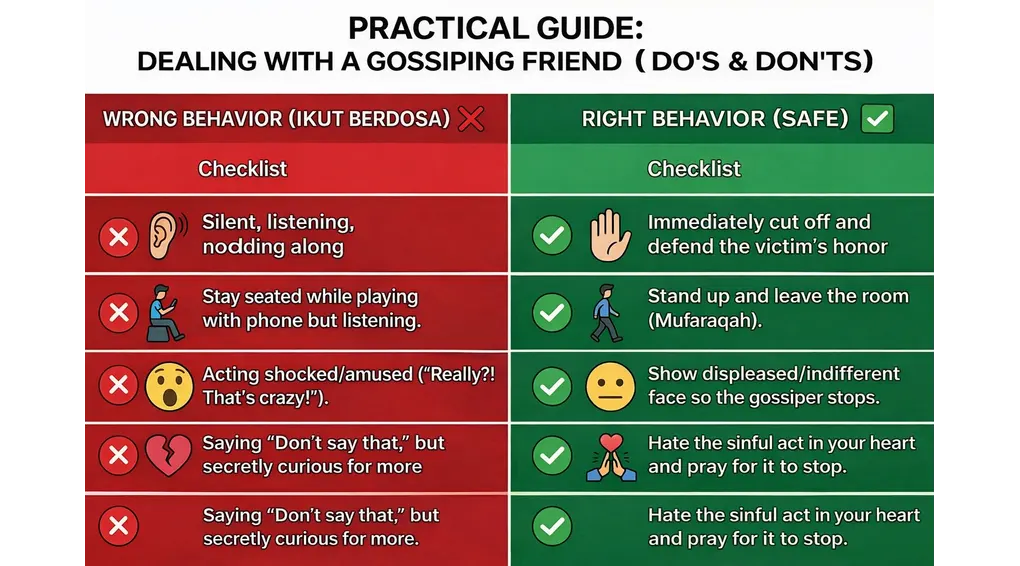
To make it easier to understand, here’s a summary of the attitude that should be taken:
| Situation | INCORRECT Attitude (Sharing the Sin) | CORRECT Attitude (Spiritually Safe) |
| A friend begins to backbite | Remaining silent, listening closely, nodding along. | Immediately cutting off the talk and defending the victim’s honor. |
| Lacking the courage to reprimand | Staying seated, playing on your phone while still listening. | Standing up and physically leaving the room (Mufaraqah). |
| Emotional response | Acting shocked/laughing (“Really?! That’s so bad!”). | Displaying a displeased or flat expression so the speaker stops. |
| State of conscience | The mouth says “Don’t do that,” but the heart is eager to hear the rest. | The heart genuinely despises the act and prays for it to stop. |
FAQ: Frequently Asked Questions About Dealing with Backbiting
What if the person committing ghibah is a parent or a supervisor at work?
This is a highly delicate situation. The core principle remains identical: you must not validate or agree with the ghibah. However, the methodology of addressing it must be significantly softer. Utilize the tactic of diplomatically changing the subject, or remain silent while maintaining a distinctly unenthusiastic facial expression. Do not verbally agree or add to the conversation. If possible, politely ask for permission to excuse yourself.
Is it permissible to listen to backbiting if the purpose is for investigation or clarification (tabayyun)?
Yes, it is permissible, but only under highly specific and strictly limited conditions—for example, during a formal judicial court proceeding, when requesting a formal legal fatwa from a qualified scholar, or when reporting a crime to the authorities. However, if it is merely casual chatter at a coffee shop, it is pure, forbidden ghibah.
I have already listened to a lot of backbiting from my friends in the past; how do I repent?
Repent instantly by begging for immense forgiveness from Allah. Furthermore, if it is practically possible and will not cause a greater evil, ask for forgiveness directly from the person who was spoken about. If meeting them is impossible or would ignite severe conflict, ardently pray for their goodness and well-being at every available opportunity. Repenting from interpersonal sins requires highly specific steps, which you can learn in our guide on seeking forgiveness for transgressing human rights (Haqqul Adami).
Conclusion: Be the “Water” That Extinguishes the Fire of Ghibah
Learning how to deal with backbiting requires significant mental courage. We frequently fear being labeled as “self-righteous” or a “killjoy.” However, constantly remember that the severe, negative consequences of ghibah in the Hereafter are utterly terrifying.
Strive to be a genuine friend. A true friend is not one who blindly accompanies their companion in committing sins; rather, a true friend is one who possesses the courage to pull their companion away from the fire of Hell.
Starting today, if the destructive fire of ghibah ignites in your social circle, be the water that extinguishes it. Whether it is by assertively reprimanding, diplomatically changing the topic, or walking away entirely. The ultimate choice lies firmly in your hands: will you be the savior of a brother’s honor, or will you become a devourer of dead flesh alongside the crowd?
Reference
Al-Ghazali, Abu Hamid Muhammad bin Muhammad. Iḥyā’ ‘Ulūm ad-Dīn. Beirut: Dar al-Ma’rifah, no date.


