
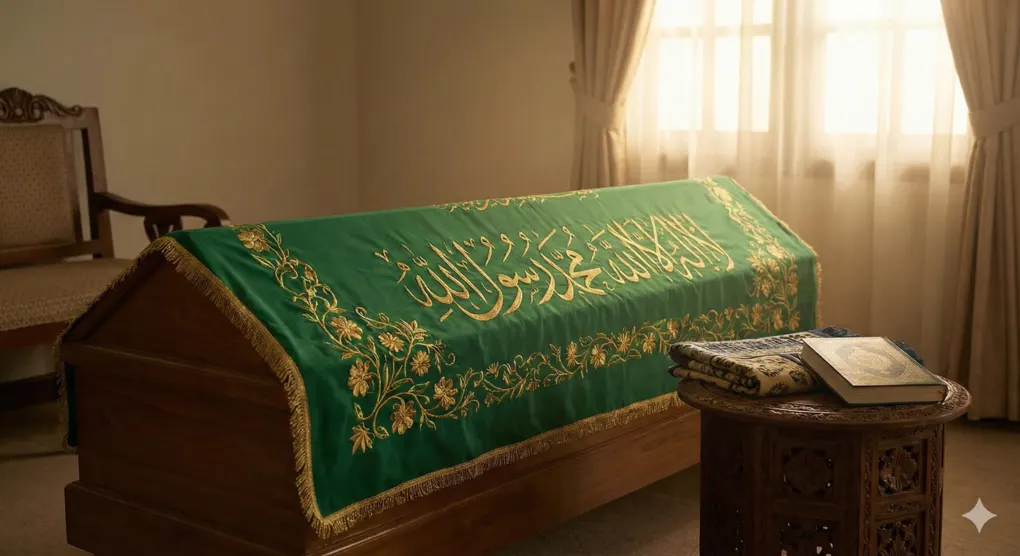
Death is an absolute certainty that will inevitably approach every living creature. In Islam, the profound respect afforded to a human being does not terminate the moment the soul departs from the physical body. The body of a Muslim possesses an inherent sanctity and honor (hurmah) that must be meticulously preserved by the living. This sacred process is recognized as tajhiz al-janazah (the preparation of the deceased), a highly noble communal act of worship.
For us as Muslims, comprehending the procedures of tajhiz al-janazah is not merely supplementary knowledge; it is an urgent necessity. We frequently find ourselves bewildered regarding exactly what must be done when a relative passes away. This comprehensive article will thoroughly dissect the guidelines of tajhiz al-janazah, directly referencing the authoritative Shafi’i fiqh manual, Asna al-Matalib Sharh Rawd al-Talib, ensuring you possess a valid, heart-soothing guide.
The Ruling of Funeral Preparations for Every Muslim
First and foremost, we must establish the jurisprudential foundation. The ruling on managing the deceased for the Muslim community is a Communal Obligation (Fard Kifayah). This signifies that the obligation is placed upon the entire Muslim populace within a specific locality. If a sufficient number of individuals execute it, the sin is entirely lifted from the rest. However, if absolutely no one undertakes it, the entire population of that locality bears the sin.
The obligation of tajhiz al-janazah inherently encompasses four primary pillars: washing (ghusl), shrouding (takfin), performing the funeral prayer (salah), and burying (dafn).
In the book Asna al-Matalib, it is explicitly stated:
قوله: (غسله وتكفينه والصلاة عليه) وحمله (ودفنه) أي كل منها (فرض كفاية)
“Washing him, shrouding him, praying over him, carrying him, and burying him; meaning each one of these is a fard kifayah.”
This obligation strictly applies to a Muslim deceased. Ultimately, executing tajhiz al-janazah is our final profound manifestation of respect towards a fellow servant of Allah, simultaneously serving as a stark reminder that we too shall soon follow them.
1. The Pre-Preparation Phase: During the Throes of Death (Sakarat al-Mawt)
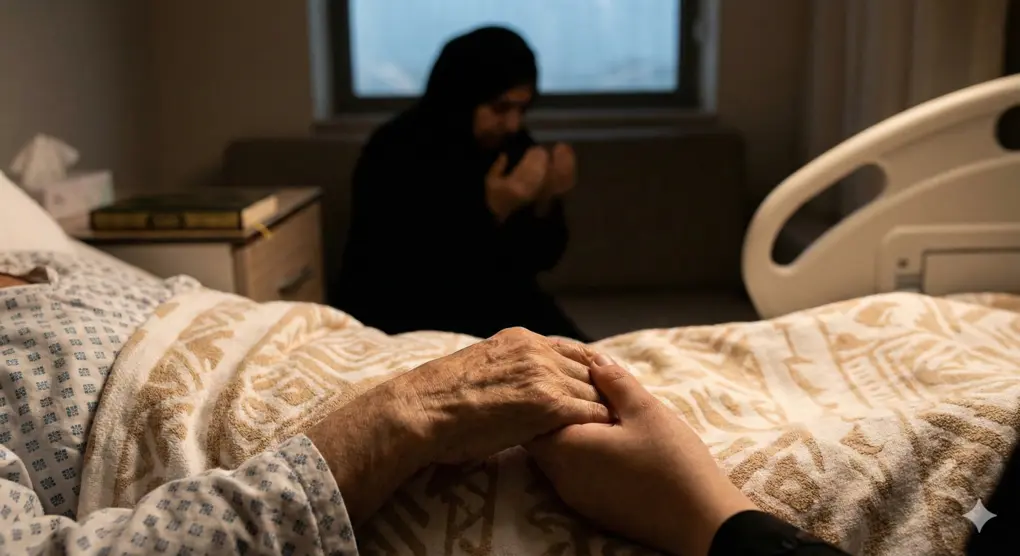
Before delving into the technicalities of preparing the corpse, it is absolutely vital for the family to comprehend the etiquette of the sick and the prophetic preparations for facing death. This is done to maximize the possibility that the patient attains a good ending (Husn al-Khatimah) while enduring naza’ (the extraction of the soul). To understand the physical indicators of death and the correct method of guiding the declaration of faith, please read our dedicated article on the signs of death and how to perform talqin.
Shaykh Zakariyya al-Ansari explains that a severely ill person should exhibit immense patience and harbor excellent expectations (Husn al-Zan) towards Allah. For the family accompanying them, it is a sunnah to gently guide (talqin) them to utter the phrase of Tawhid (La ilaha illallah) without any coercion.
قوله: (و) أن (يلقنه) الشهادة (غير الوارث)… (بلا زيادة) عليها
“And that a non-heir should prompt him with the Shahadah… without any addition to it.”
Once death is definitively confirmed, immediately close their eyes, tie their jaw shut to prevent the mouth from gaping, and gently flex their joints while the body remains warm. This will significantly facilitate the subsequent stages of tajhiz al-janazah, particularly the washing process. You can find the technical guide on how to perform these immediate actions in our article: First aid for the deceased: 4 things to do immediately.
2. The Procedure of Washing the Deceased (Al-Ghusl)
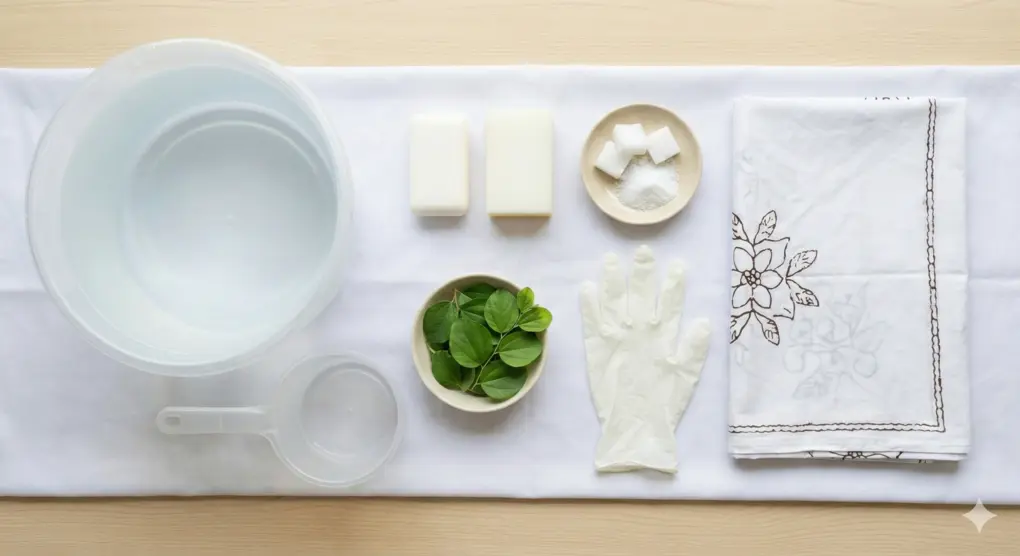
The inaugural step in our obligation towards the deceased is the ritual washing. The primary objective is to physically purify the corpse from all filth (najis) and dirt so that they may face Allah in a state of absolute purity.
Prepare pure (mutlaq) water, sidr (lote tree) leaves, and camphor (kafur). Ensure you understand the correct measurements and precise timing for their application so the deceased’s fragile skin is not damaged. The detailed guide for mixing the water can be found at: Rulings on using cold water, sidr, and camphor for the deceased.
Conditions and Stipulations
- Location: Must be fully enclosed and completely shielded from the view of anyone other than the washers.
- Water: It is a sunnah to utilize cold water as it firms the corpse’s flesh. Warm water is strictly permitted only if the weather is freezing or to eradicate stubborn filth.
- Covering: The deceased’s ‘awrah (the area between the navel and the knees) MUST remain covered throughout the entire washing process. It is vastly superior to wash them while they are wearing a thin, loose shirt (qamis).
Technical Execution
Based on Asna al-Matalib, the procedure for the ritual bath is as follows:
- Position: Elevate the deceased on a washing board or table.
- Cleansing the Abdomen: Sit the deceased up slightly, support their back, and gently massage the abdomen downward to expel any remaining excrement. Clean the front and rear private parts using the left hand wrapped in a thick cloth glove.
- Wudu: Perform a complete ablution (wudu) on the deceased, precisely like the wudu of a living person (accompanied by the intention to wash/perform wudu for the deceased).
- The Washes: Utilize water mixed with sidr leaves or soap.
- Wash the head and beard.
- Wash the entire right side of the body (front and back).
- Wash the entire left side of the body (front and back).
- Ensure water comprehensively covers the entire body at least once (which is obligatory). Three washes are sunnah.
- The Final Rinse: The ultimate rinse must be mixed with crushed camphor (kafur) for preservation and a pleasant fragrance.
قوله: (وأقل الغسل استيعاب البدن) بالماء (مرة بعد إزالة النجس)
“The minimum of washing is encompassing the body with water once after removing the impurity.”
Within the washing process, there exists a minimum valid threshold and a perfect, sunnah method. To discover the detailed Arabic intentions and the exact pouring techniques, read the comprehensive guide in: How to wash a dead body in Islam: Minimum vs Perfect method.
3. The Procedure of Shrouding the Deceased (At-Takfin)
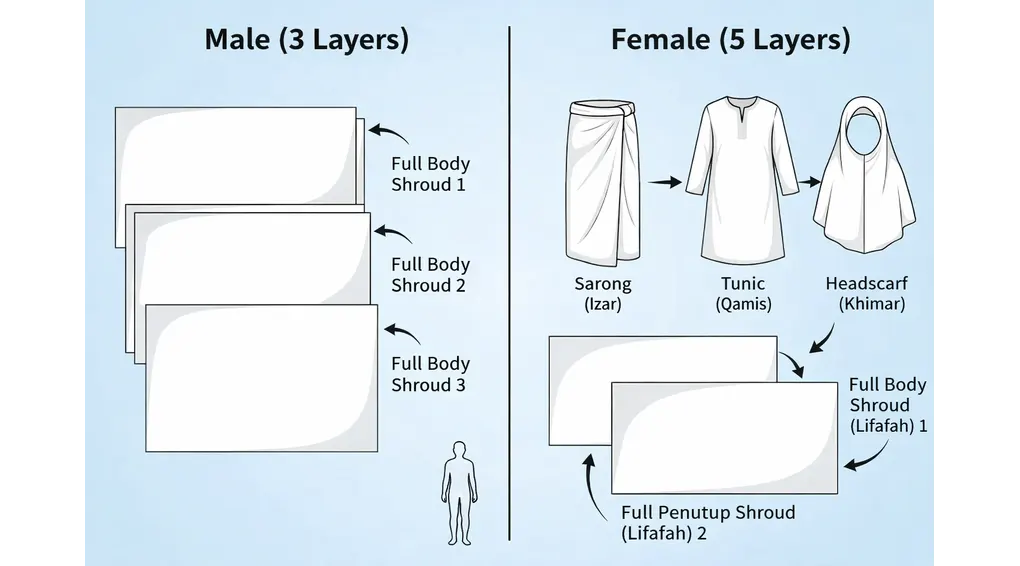
Once purified and thoroughly dried with a towel, the subsequent step in tajhiz al-janazah is shrouding (takfin). The burial shroud should ideally be white, clean, and sufficiently thick (non-transparent).
The Number of Shrouds




- Male: It is sunnah to utilize 3 separate, wide sheets of white cloth, each capable of covering the entire body, without a sewn shirt or a turban.
- Female: It is sunnah to utilize 5 distinct pieces, consisting of:
- A lower wrap (izar).
- A sewn, sleeveless shirt (qamis).
- A head covering/veil (khimar).
- Two large outer sheets covering the entire body (lifafah).
The Shrouding Procedure
Spread out the shroud cloths that have been previously perfumed (e.g., with oud or camphor smoke). Gently place the deceased upon them. Plug the bodily orifices (nose, ears, etc.) and the places of prostration with cotton. Fold the cloth tightly from the left side over to the right, then from the right side over to the left. Secure the shroud with cloth ties that will eventually be untied once inside the grave.
قوله: (وأقله) أي الكفن (ثوب) لحصول الستر به (يعم البدن)
“And its minimum (the shroud) is one garment to achieve covering with it, encompassing the body.”
4. The Procedure of the Funeral Prayer (Salat al-Janazah)
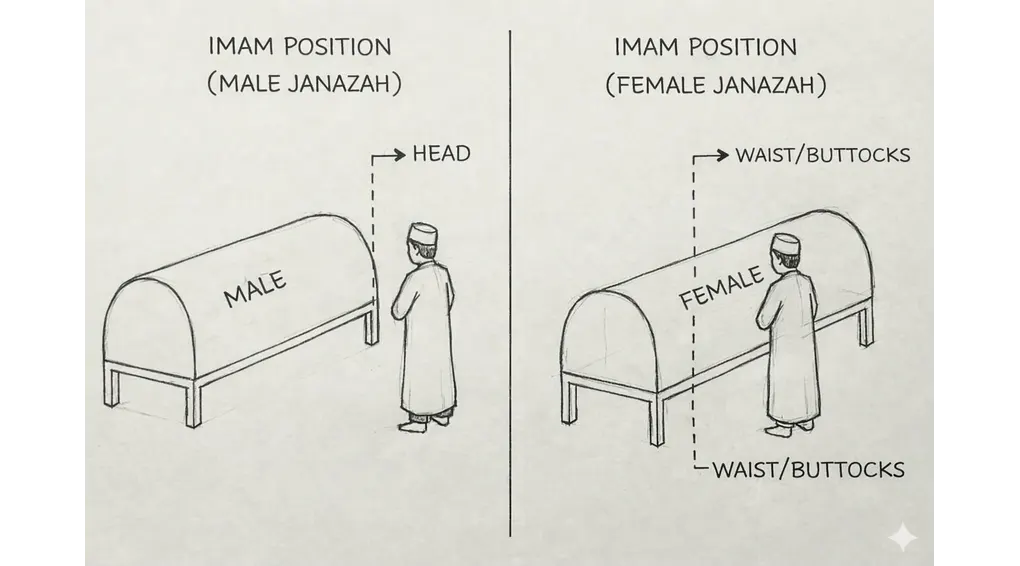
This is the spiritual core of tajhiz al-janazah: intensely supplicating for divine forgiveness for the deceased. The funeral prayer uniquely contains no bowing (ruku’) or prostration (sujud); it consists entirely of standing and reciting 4 Takbirs. Ensure you understand the absolute necessity of the opening Takbiratul Ihram to validate the prayer.
Pillars of the Funeral Prayer
- Intention (Niyyah): Intending to perform the obligatory funeral prayer, simultaneous with the Takbiratul Ihram.
- Niyyah: “Ushalli ‘ala hadzal mayyiti fardha kifayatin lillahi ta’ala.”
- Standing: Mandatory for those physically capable.
- Four Takbirs:
- First Takbir: Recite Surah Al-Fatihah.
- Second Takbir: Recite the virtuous blessings upon the Prophet (Allahumma shalli ‘ala Muhammad…).
- Third Takbir: Supplicate specifically for the deceased. This is the most crucial pillar.
- Dua: Allahummaghfir lahu warhamhu wa ‘afihi wa’fu ‘anhu (Male)… Allahummaghfir laha warhamha wa ‘afiha wa’fu ‘anha (Female).
- Fourth Takbir: Recite the final dua: Allahumma la tahrimna ajrahu wala taftinna ba’dahu waghfirlana walahu/Allahumma la tahrimna ajraha wala taftinna ba’daha waghfirlana walaha… followed immediately by the Salam.
وأركانها سبعة الأول النية… الثَّانِي الْقِيَام… الثالث التكبيرات الأربع…الرابع السلام بعدها… الخامس قراءة الفاتحة… السادس الصلاة على النبي… السابع أدنى الدعاء للميت
“Its pillars are seven: The first is intention… the second is standing… the third is the four takbirs… the fourth is the salam after them… the fifth is reciting Al-Fatihah… the sixth is sending blessings upon the Prophet… the seventh is the minimum supplication for the deceased.”
Imam’s Position: The Imam stands directly adjacent to the head of a male deceased, and adjacent to the hips/midsection of a female deceased.
5. The Procedure of Burial (Ad-Dafn)
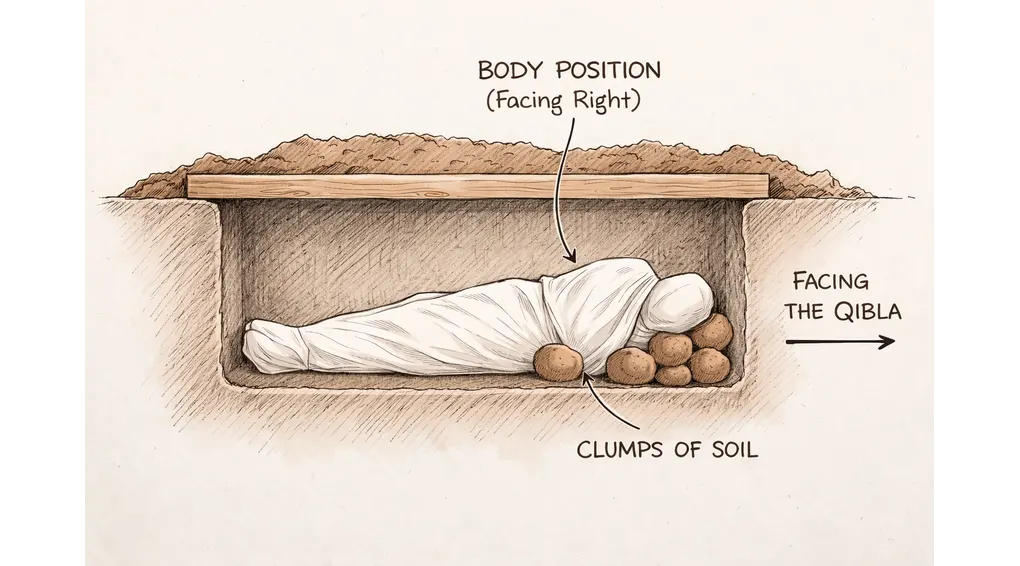
The final phase of tajhiz al-janazah is the burial. Islam strictly mandates that the physical body be returned to the earth in a deeply dignified manner.
Grave Specifications
The ruling requires ensuring the grave is dug sufficiently deep (approximately the height of an average standing man plus an extended arm) to completely prevent foul odors from escaping and to absolutely protect the body from scavenging animals. There are two primary excavation models:
- Lahd (Niche): A lateral cavity dug into the Qibla-facing wall at the bottom of the grave (highly recommended for solid, firm soil).
- Shaqq (Trench): A trench dug directly down the middle of the grave floor (utilized primarily for loose, sandy soil).
The Burial Procession
- Lower the deceased gently into the grave feet-first from the foot-end of the grave.
- Place the deceased resting entirely on their right side, specifically facing the Qibla. This is strictly obligatory.
- Place the deceased’s right cheek in direct physical contact with the earth. Untie all the cloth bands securing the shroud.
- Support their back firmly with clods of earth to ensure they do not roll backward onto their back.
- Seal the niche (Lahd) with wooden planks or unbaked bricks, then systematically fill the grave with earth.
قوله: (والاستقبال به) القبلة (واجب) تنزيلا له منزلة المصلي
“Facing him towards the Qibla is obligatory, placing him in the position of the one praying.”
Summary Table: Differences Between Male and Female Procedures
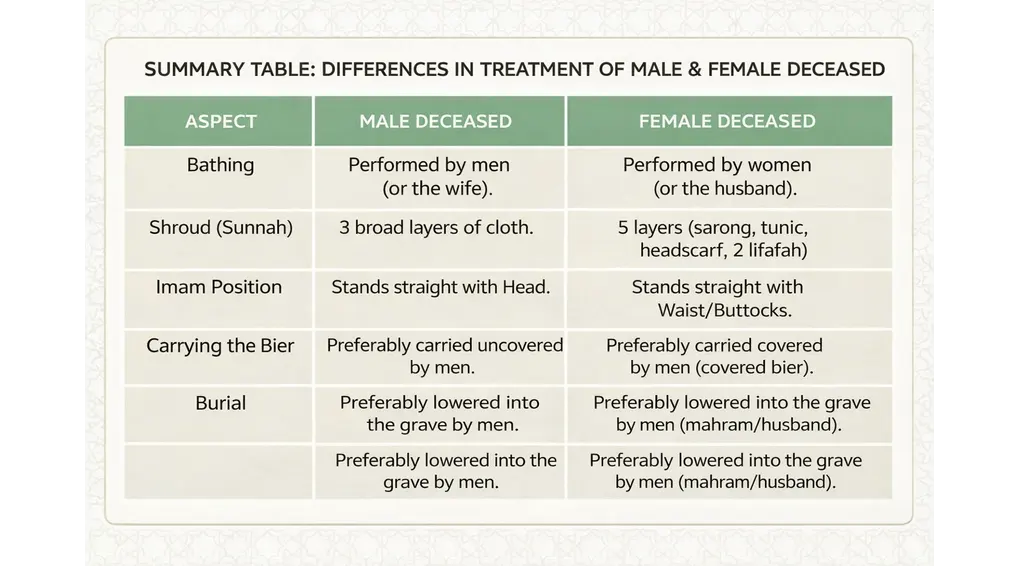
To facilitate rapid comprehension, here is a concise summary table highlighting the fundamental differences in tajhiz al-janazah:
| Aspect | Male Deceased | Female Deceased |
| The Washers | Exclusively Men (or his wife). | Exclusively Women (or her husband). |
| Shroud (Sunnah) | 3 wide, simple sheets. | 5 pieces (wrap, shirt, veil, 2 outer sheets). |
| Imam’s Position | Stands aligned with the Head. | Stands aligned with the Hips/Midsection. |
| The Bier (Keranda) | Carried by men (open bier). | Sunnah to be covered with a canopy (kurung batang). |
| Lowering into Grave | Executed by men. | Executed strictly by men (specifically mahram or husband). |
Frequently Asked Questions (FAQ)
Is it permissible for a husband to wash the body of his deceased wife?
Yes, it is entirely permissible. The text Asna al-Matalib explicitly clarifies that a husband retains the absolute right to wash his wife, and vice versa. This is because the sacred bond of marriage is not entirely severed by death within this specific jurisprudential context.
What must be done if the corpse is mutilated or physically incomplete?
If the corpse is severely destroyed (e.g., a severe burn victim) and the physical act of washing would further damage or disintegrate the body, the obligation of ghusl is entirely substituted with Tayammum (dry purification). The procedure involves gently striking pure dust and wiping it over the deceased’s face and hands.
What is Talqin for the dead, and what is its ruling?
Talqin for the dead is the act of verbally prompting/reminding the newly buried deceased with the declaration of Tawhid and the correct answers for the imminent interrogation by the angels Munkar and Nakir. According to the official stance of the Shafi’i Madhhab, its ruling is a highly recommended Sunnah.
Is it obligatory to perform the funeral prayer for a miscarried fetus?
If the fetus is born and exhibits explicit signs of life (e.g., crying or moving) before dying, the funeral prayer is strictly obligatory. If it is stillborn but the pregnancy had already surpassed 4 lunar months (the soul had been blown into it), it is obligatory to wash, shroud, and bury it. However, it is not prayed over according to the official Shafi’i stance, although a minority of scholars permit the prayer as a supplication of mercy for the grieving parents.
Closing
Executing tajhiz al-janazah correctly is the ultimate testament of our care, empathy, and immense responsibility as a unified Muslim Ummah. Tajhiz al-janazah transcends a mere physical, logistical ritual; it is a profound act of worship heavily saturated with spiritual significance and powerful supplications.
We fervently hope this comprehensive guide, grounded in the classical text Asna al-Matalib, proves immensely beneficial and facilitates profound ease in fulfilling the sacred rights of our brothers and sisters who have returned to Allah. Let us continuously purify our intentions, rigorously study the sacred knowledge, and implement it with absolute sincerity. Wallahu a’lam bis-sawab.
Referensi & Catatan Kaki
al-Anṣārī, Zakariyā. Asnā al-Maṭālib fī Sharḥ Rawḍ al-Ṭālib. With a ḥāshiyah by Aḥmad al-Ramlī. Edited by Muḥammad az-Zuhrī al-Ghamrāwī. Cairo: al-Maṭbaʿah al-Maymānīyah, 1313 H. Reprinted by Dār al-Kitāb al-Islāmī.


