

Confused about the ruling on tawassul? Read this comprehensive guide sourced from authoritative Ahl al-Sunnah wal Jama’ah (Aswaja) texts. Equipped with authentic hadith transliterations, rational theological logic, and robust refutations against accusations of polytheism (shirk), this discussion provides thorough and heart-soothing clarity.
In the midst of today’s noisy differences of opinion among the Ummah, the topic of tawassul frequently becomes a heated point of debate. Some of our brothers and sisters fear this practice leads to polytheism, while the vast majority of Muslims believe it to be a profound expression of love for Allah and His Messenger ﷺ.
This article is not here to muddy the waters, but to scientifically situate the matter based on two authoritative reference books: “Ad-Dhakha’ir Al-Muhammadiyyah” by Prof. Dr. Sayyid Muhammad bin Alawi Al-Maliki and “Al-Ifham wa al-Ifham” by Shaykh Sayyid Zaky Ibrahim. Let us examine this issue with a clear heart, solely seeking the pleasure of Allah Subhanahu wa Ta’ala and the intercession of the Messenger of Allah ﷺ.
1. The Essence of Tawassul: A Quranic Command, Not an Innovation
Linguistically, tawassul means adopting a means or an intermediary (wasilah) to draw closer to a desired goal. In the context of worship, Tawassul in Islam means supplicating to Allah by incorporating something beloved to Allah—such as righteous deeds, His Beautiful Names, or the essence of Prophets and Saints—so that the prayer is answered more swiftly.
The primary foundation is the direct command of Allah the Exalted in the Holy Quran:
يَا أَيُّهَا الَّذِينَ آمَنُوا اتَّقُوا اللَّهَ وَابْتَغُوا إِلَيْهِ الْوَسِيلَةَ
“O you who have believed, fear Allah and seek the means [wasilah] to Him…” (QS. Al-Ma’idah: 35).
This verse is general (‘am). The wasilah can manifest as acts of worship (like prayer and fasting), and according to the vast majority of scholars (jumhur), wasilah inherently includes performing tawassul through the honor of the Prophets and the righteous.
The Fundamental Difference Between Tawassul and Shirk
The greatest fallacy of those who reject tawassul is erroneously equating it with the practices of the polytheists (mushrikin) who worshipped idols. The distinction is exceptionally stark:
- Shirk (Worship): The polytheists believed their idols (Latta, Uzza, etc.) were minor deities (Arbab) possessing autonomous power independent of Allah. They worshipped those physical objects.
- Tawassul (Supplication): The person performing tawassul firmly believes in La ilaha illallah (There is no deity but Allah). They are absolutely certain that Prophets and Saints possess zero independent power to bring benefit or inflict harm. Prophets and Saints are merely beloved “doors” or intermediaries to Allah, not deities to be worshipped.
2. Theological Logic: Why Tawassul is Not Grave Worship
Shaykh Sayyid Zaky Ibrahim, in his book Al-Ifham wa al-Ifham, provides a brilliant rational argument (Dalil Aqli) to dismantle the accusation of physical worship.
The Elephant and Gold Analogy
If tawassul were genuinely based on the veneration of a physical body or material flesh, humanity would logically be better off worshipping an Elephant or a Block of Gold.
Why? Because physically, an elephant is exponentially larger and stronger than a human body. Materially, gold is astronomically more valuable than human flesh and bone. However, factually, Muslims do not perform tawassul to elephants or gold.
We perform tawassul to Prophets and Saints not because of their physical bodies, but because of the “Eternal Value” (Ma’na al-Khalid) residing within their souls: Faith, Piety, Jihad, Knowledge, and Sincerity. It is these spiritual values that are eternal and do not decompose in the earth. Discover the definitive Elephant and Gold logic that thoroughly refutes accusations of grave worship.
The “Rabbani” Concept and the Vessel (Wi’a)





The Saints of Allah (Awliya) are likened to a “Vessel” (Wi’a). We honor the vessel solely because of its magnificent contents (the Light of Allah). In a Hadith Qudsi narrated by Imam Bukhari, Allah declares regarding His Saint:
…فَإِذَا أَحْبَبْتُهُ: كُنْتُ سَمْعَهُ الَّذِي يَسْمَعُ بِهِ, وَبَصَرَهُ الَّذِي يُبْصِرُ بِهِ, وَيَدَهُ الَّتِي يَبْطِشُ بِهَا, وَرِجْلَهُ الَّتِي يَمْشِي بِهَا…
“…When I love him, I become his hearing with which he hears, his seeing with which he sees, his hand with which he strikes, and his foot with which he walks…”
This signifies that the Saints do not act with their own independent strength, but act as instruments of Allah’s will (Rabbani). Performing tawassul through them is, in reality, supplicating to Allah through a channel that Allah Himself is pleased with. To understand these theological secrets deeper, read the comprehensive explanation of the Rabbani Concept and why the prayers of Saints are highly efficacious.
3. Scriptural Evidence: Authentic Hadiths on Tawassul
Below is irrefutable evidence that the Messenger of Allah ﷺ actively taught and practiced tawassul.
A. The Hadith of the Blind Man (Direct Tutorial from the Prophet)
Narrated by Uthman bin Hunaif (may Allah be pleased with him), a blind man came complaining to the Prophet. The Prophet instructed him to perform wudu, pray two rakaat, and then recite this specific supplication:
اللَّهُمَّ إِنِّي أَسْأَلُكَ وَأَتَوَجَّهُ إِلَيْكَ بِنَبِيِّكَ مُحَمَّدٍ نَبِيِّ الرَّحْمَةِ، يَا مُحَمَّدُ إِنِّي تَوَجَّهْتُ بِكَ إِلَى رَبِّي فِي حَاجَتِي هَذِهِ لِتُقْضَى لِي، اللَّهُمَّ فَشَفِّعْهُ فِيَّ
Transliteration: Allahumma inni as’aluka wa atawajjahu ilaika bi nabiyyika Muhammad, nabiy ar-rahmah. Ya Muhammad, inni tawajjahtu bika ila Rabbi fi hajati hadhihi li-tuqda li. Allahumma fa-shaffi’hu fiyya.
Meaning: “O Allah, I ask You and turn to You through Your Prophet Muhammad, the Prophet of Mercy. O Muhammad, I turn through you to my Lord concerning this need of mine so that it may be fulfilled for me. O Allah, accept his intercession for me.”
Crucial Points:
- The Prophet taught the phrase “Bi Nabiyyika” (through Your Prophet / the essence of the Prophet), not “Bi Du’a Nabiyyika” (through the prayer of Your Prophet).
- There is a direct address, “Ya Muhammad,” representing the spiritual presence of the Prophet.
- This hadith is authenticated (Sahih) by Al-Hakim, At-Tirmidhi, Ibn Majah, and its authenticity is agreed upon by Adh-Dhahabi.
B. The Hadith of Fatimah bint Asad (Tawassul with Previous Prophets)
When Fatimah bint Asad (the mother of Ali bin Abi Talib) passed away, the Messenger of Allah ﷺ descended into her grave and prayed:
اغْفِرْ لأُمِّي فَاطِمَةَ بِنْتِ أَسَدٍ… بِحَقِّ نَبِيِّكَ وَالأَنْبِيَاءِ الَّذِينَ مِنْ قَبْلِي
Transliteration: Ighfir li-ummi Fatimah bint Asad… bi haqqi nabiyyika wal-anbiya’ alladhina min qabli…
Meaning: “Forgive my mother Fatimah bint Asad… by the right of Your Prophet and the Prophets who were before me…”
This hadith is narrated by Al-Tabarani, Ibn Hibban, and Al-Hakim. This unequivocally proves that the Prophet ﷺ performed tawassul through Prophets who had passed away centuries prior.
C. The Hadith of “Haqq as-Sa’ilin”
The Messenger of Allah ﷺ taught a specific prayer when leaving the house for the mosque:
اللَّهُمَّ إِنِّي أَسْأَلُكَ بِحَقِّ السَّائِلِينَ عَلَيْكَ
Transliteration: Allahumma inni as’aluka bi haqqi as-sa’ilina ‘alayka…
Meaning: “O Allah, I ask You by the right of those who ask You…”
This hadith is graded as good (Hasan) by Al-Hafiz Al-Mundhiri and Al-Hafiz Ibn Hajar, demonstrating the permissibility of performing tawassul through the general status of righteous servants.
4. Is Tawassul Prohibited After the Prophet’s Death?
A frequent doubt (shubhah) arises: “Tawassul was permissible when the Prophet was alive, but it became forbidden after his death.” Let us examine the historical facts of the Companions (Salaf al-Salih).
The Story of a Companion During the Caliphate of Uthman bin Affan
A man had a pressing need with Caliph Uthman bin Affan but struggled to gain an audience. He complained to Uthman bin Hunaif (the narrator of the blind man’s hadith).
Uthman bin Hunaif instructed him to perform wudu, pray, and recite the exact “Ya Muhammad…” prayer taught to the blind man. The man did so, and immediately, he was respectfully received by Caliph Uthman bin Affan, and his need was fulfilled.
This event occurred after the Prophet’s death. This is definitive proof (Nass Qat’i) that the Companions believed tawassul through the Prophet remains valid forever.
Clarifying the Story of Umar and Al-Abbas
The incident where Umar bin Khattab performed tawassul through the Prophet’s uncle, Al-Abbas, to seek rain is often grossly misunderstood as a prohibition against performing tawassul at the Prophet’s grave.
The Explanation:
- Umar did this because of Fiqh reasons: The prayers for asking for rain (Salat al-Istisqa) legally requires a physically living Imam to lead the congregational prayer.
- The shift to Al-Abbas actually demonstrates the permissibility of performing tawassul through the Family of the Prophet (Ahl al-Bayt) and righteous individuals other than the Prophet.
- Umar himself stated in his prayer: “O Allah, we used to ask You for rain by means of our Prophet… and now we ask You for rain by means of the uncle of our Prophet.”
Aisha and the Roof of the Prophet’s Tomb
When Medina was struck by a severe drought, Aisha (may Allah be pleased with her) instructed the residents:
فَاجْعَلُوا مِنْهُ كُوًى إِلَى السَّمَاءِ حَتَّى لَا يَكُونَ بَيْنَهُ وَبَيْنَ السَّمَاءِ سَقْفٌ
“Make a hole (kuwah) from the direction of the Prophet’s grave penetrating to the sky, so that there is no roof between him and the sky.”
After this was done, rain poured heavily. This is a profound form of physical tawassul (Tabarruk) with the Prophet’s grave, commanded directly by the Mother of the Believers.
5. The Realm of Barzakh: The Connection Between the Living and the Dead
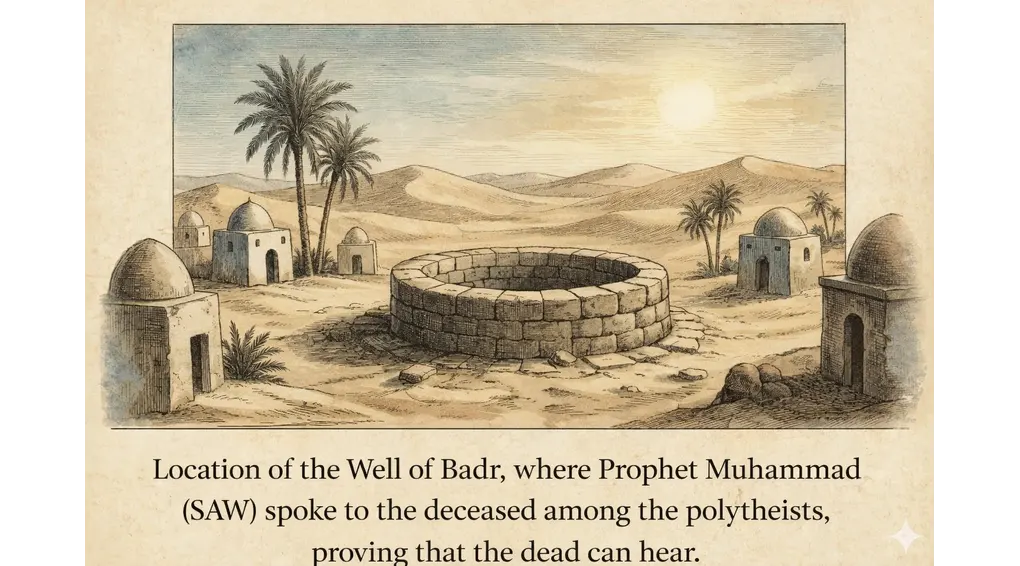
In the view of Ahlussunnah, death is not non-existence, but a transition to another realm. The soul of the believer, especially the Prophets, remains alive and hears.
The Messenger of Allah, peace and blessings be upon him, said to the corpses of the polytheists in the well of Badr:
مَا أَنْتُمْ بِأَسْمَعَ لِمَا أَقُولُ مِنْهُمْ
“You do not hear what I say any better than they do.”
The most logical daily proof is within our obligatory prayers (Salah). We recite the greeting:
السَّلَامُ عَلَيْكَ أَيُّهَا النَّبِيُّ وَرَحْمَةُ اللَّهِ وَبَرَكَاتُهُ
“Peace be upon you, O Prophet, and the mercy of Allah and His blessings.”
Utilizing the second-person pronoun (Kaf Khitab / You) signifies that the Prophet is spiritually present (Hadhir) and hears the greetings of his Ummah. If the Prophet were obliterated and deaf, we would not have been taught to address him directly every single day.
6. Conclusion and the Views of the Madhhab Imams
This practice of tawassul is firmly upheld by the Imams of the Madhhabs:
- Imam Ahmad bin Hanbal: Allowed tawassul through the Prophet ﷺ in supplications, as documented in the book Al-Mansak.
- Imam Al-Shafi’i: He frequently visited the grave of Imam Abu Hanifah to perform the prayer of need (Salat al-Hajah) and perform tawassul there, acknowledging that his needs were swiftly fulfilled.
Summary Table: Tawassul vs. Shirk
| Aspect | Tawassul (Islamic Teaching) | Shirk (Polytheistic Teaching) |
| Destination of Dua | Asking from Allah SWT alone. | Asking from Idols/Deities. |
| Position of Intermediary | Beloved servant of Allah (Wasilah). | Minor God/Partner (Arbab). |
| Conviction of Heart | Only Allah has the power to grant. | Idols possess independent power. |
| Example | “O Allah, I ask by the blessing of Your Prophet.” | “O Latta, send down the rain.” |
FAQ (Frequently Asked Questions)
Isn’t praying directly to Allah better? Why is an intermediary necessary?
Indeed, Allah is All-Near. However, Allah is also the one who established the law of “Cause and Effect.” We take medicine to heal (an intermediary), even though Allah is the ultimate Healer. Tawassul represents the etiquette of approaching a King. We bring an “insider” (the King’s Beloved) so our request receives more attention, acutely aware that we are burdened with many sins.
Is the hadith regarding tawassul weak (da’if)?
No. The hadith of the blind man is graded as Sahih by hadith masters such as Al-Tirmidhi, Al-Hakim, and Adh-Dhahabi. The accusation that its narrators (like Malik Ad-Dar or Abu Ja’far) are unknown (majhul) has been thoroughly refuted scientifically. Abu Ja’far is a highly reliable (thiqah) narrator.
Is it permissible to call out “Ya Nabi” or “Ya Wali” at a grave?
Yes, as long as the intention is a vocal call (Nida’) to their living souls in the presence of Allah, and absolutely not an act of worship. It is identical to us calling out “Ya Nabi Salam ‘Alaika” during Mawlid or during the tashahhud before concluding the prayer.
Can we perform tawassul through the deceased?
Yes, and it is legislated. The majority of scholars (Jumhur) agree on the permissibility of tawassul through the Prophet or righteous people, whether they are alive or have passed away. The proofs are:
Hadith Fatimah bint Asad: The Prophet ﷺ himself performed tawassul utilizing the rights of the Prophets who had died before him.
Practice of the Companions: Uthman bin Hunaif taught the tawassul prayer during the reign of Caliph Uthman bin Affan (after the Prophet’s death).
What is the fundamental difference between tawassul and shirk?
The difference lies entirely in the theological conviction of the heart and the status of the intermediary:
Shirk: Believing the intermediary (like an idol) possesses independent power (Arbab) to bring benefit or harm alongside Allah, and worshipping them.
Tawassul: Believing that only Allah grants prayers. The Prophet or Saint is merely a beloved servant (Wasilah). We do not worship them; we request that our prayers be heard by Allah by virtue of that righteous person’s honor.
How does one perform tawassul correctly?
The method taught directly by the Messenger of Allah ﷺ in the authentic hadith to the blind companion is:
Perform wudu perfectly and pray two rakaat.
Recite the dua: “Allahumma inni as-aluka wa atawajjahu ilaika bi nabiyyika Muhammad…” (O Allah, I ask You and turn to You through Your Prophet Muhammad…).
Mention the specific desired need. This phrasing affirms that the ultimate target of the prayer remains Allah (As-aluka), but it is routed through the Prophet (Bi Nabiyyika).
Do the Prophet and righteous deceased hear our greetings/prayers?
Yes, they hear.
Evidence from the Hadith of Badr: The Prophet SAW spoke to the corpses of the polytheists in the well of Badr. When a companion asked, the Prophet replied: “You do not hear my words any more than they do.”
Evidence from Prayer: Every day in prayer, we say “As-Salamu ‘alayka Ayyuhan Nabiyyu” (Peace be upon you, O Prophet). The use of the second-person pronoun (“You”) indicates that the Prophet is present and hears the greetings of his ummah. If he did not hear, we would not have been taught to greet him directly in worship.
Why did Umar bin Khattab use Abbas as a means of intercession, and not the Prophet’s grave?
Umar r.a.’s action of requesting rain (Istisqa) through the Prophet’s uncle, Al-Abbas r.a., was not because seeking blessings from the Prophet’s grave is forbidden, but rather due to the reason of Fiqh of the Istisqa Prayer:
The Istisqa prayer requires a physically living imam to lead the prayer and supplication with the Muslims, something that a deceased person cannot do.
Umar wanted to demonstrate the honor of the Ahlul Bait (the Prophet’s family) and to take blessings from the Prophet’s living close relatives.
Indeed, in his supplication, Umar said: “O Allah, we used to seek blessings through Your Prophet… now we seek blessings through the Prophet’s uncle,” which demonstrates the continuity of the practice of tawassul.
Conclusion
Tawassul is an integral part of the rich Islamic tradition, possessing an unshakeable foundation in both scriptural evidence (Dalil Naqli) and sound theological reasoning (Dalil Aqli).
Accusing fellow Muslims of polytheism (shirk) simply because they perform tawassul is a reckless and dangerous act. As we have discussed, tawassul is not grave worship or the worship of physical human beings; rather, it is the profound honoring of eternal values of piety in the sight of Allah.
We pray that this comprehensive explanation expands our hearts and protects us from harboring ill thoughts toward our fellow Muslims. Wallahu a’lam bish-shawab.
Reference
Ibrahim, Muhammad Zaki. Al-Ifhām and Al-Ifḥām: Issues of Intermediaries and Graves in the Light of Islamic Tolerance.
Al-Maliki, Muhammad bin ‘Alawi bin ‘Abbas al-Makki al-Hasani. Al-Dzakhā’ir al-Muḥammadiyyah fī Faḍl…. With additional notes Buḥūts Hāmmah wa Taḥqīqāt Ta‘alluqu bi Mawāḍi‘ al-Naqd wa al-I‘tirāḍāt by Jamāl Fārūq Jibrīl Maḥmūd al-Daqqāq. Cairo: Dār Jawāmi‘ al-Kalim.


