
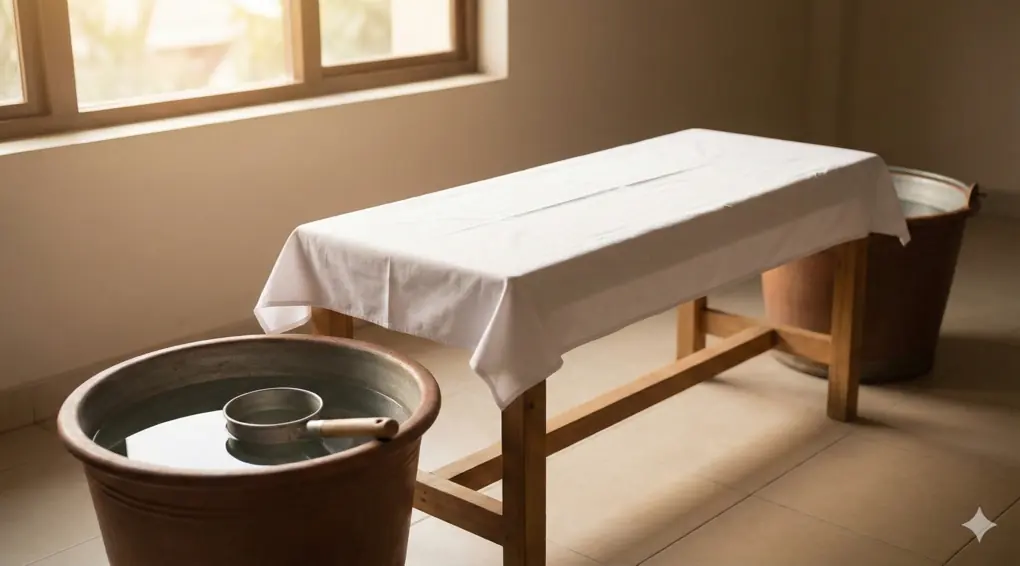
Many individuals experience profound nervousness or fear when asked to participate in washing a deceased person. A massive anxiety looms: “What if I make a mistake? What if the washing is invalid?”
In reality, Islam is a religion fundamentally built upon ease. During emergency circumstances (such as a severe water shortage, a body in poor physical condition, or extreme time constraints), we are not obligated to perform a lengthy, intricate ritual. There is a definitive minimum threshold that renders the washing legally valid. However, during normal circumstances, we naturally desire to offer the finest final respects by executing the procedure perfectly (akmal).
This article will thoroughly dissect two methods of how to wash a dead body in Islam: The Minimum Method (Strictly for Validity) and the Perfect Procedure (Sunnah), complete with the Arabic intention (niyyah), supplications, and technical execution based on the classical text Asna al-Matalib.
Before any water is poured, ensure the physical condition of the corpse is properly prepared. If the deceased’s joints are stiff or the mouth remains open, perform the immediate physical handling as detailed in our guide on actions to take immediately after someone dies to ensure a smooth washing process.
Two Levels in Washing the Deceased
Shafi’i scholars categorize the method of washing the deceased into two distinct levels. Comprehending this differentiation is crucial so you do not panic when confronted with less-than-ideal situations.
1. The Minimum Threshold: Merely Valid (Al-Aqall)
This is the “shortcut” permitted by the Sharia. If these conditions are fulfilled, the communal obligation (fard kifayah) is discharged, and the deceased may be shrouded.
In the book Asna al-Matalib, Shaykh Zakariyya al-Ansari explains:
فصل: (وأقل الغسل استيعاب البدن) بالماء (مرة بعد إزالة النجس) عنه إن كان فلا تكفي لهما غسلة واحدة, وهذا مبني على ما صححه الرافعي في الحي من أن الغسلة لا تكفي عن الحدث والنجس …… (وإن كان جنبا) أو حائضا كما سيأتي; لأن الطهارات تتداخل (ولو بلا نية) ؛ لأن القصد من غسله النظافة, وهي لا تتوقف على نية; ولأنها إنما تشترط في سائر الأغسال على المغتسل لا الغاسل والميت ليس من أهلها
“Section: The minimum of washing is encompassing the body with water once after removing the impurity from it, if there is any. Thus, a single wash does not suffice for both (removing impurity and lifting ritual impurity simultaneously). This is built upon what al-Rafi’i authenticated regarding the living… And if the deceased was in a state of major ritual impurity (junub) or menstruating… a single wash suffices because purifications interpenetrate. (Even without an intention); because the purpose of washing is cleanliness, and that does not depend on an intention. Furthermore, intention is only stipulated in other baths for the one bathing himself, not the washer, and the deceased is no longer capable of it.”
Therefore, the absolute minimum standard consists of merely two steps:
- Remove Impurity (Najis): Ensure absolutely no physical filth remains attached to the body.
- Pour Evenly Once: Pour pure water over the entire body (from the hair down to the tips of the toes) exactly one time.
Finished. The deceased is legally considered pure. This method is exceptionally useful for disaster victims or during severe water crises.
2. The Perfect Procedure for Washing the Deceased (Al-Akmal)
This method is saturated with high etiquette (adab) and extreme caution, guarding the honor of the deceased precisely as if they were still alive. Below is the detailed sequence based on Asna al-Matalib:
A. Preparation and Protection (Satru & Khalwah)
The deceased must not be washed in an open area visible to random onlookers.
- A Closed Area (Khalwah):
It is a sunnah to wash the body in a secluded, enclosed space, under a roof, to fiercely protect any physical flaws from exposure.
قوله: (ويغسل في خلوة) … (وللولي الدخول) … (وإن لم يعن)
“He is washed in seclusion… and the guardian (close family) may enter… even if they do not assist.”
- Using a Garment (Qamish):
This is a highly recommended sunnah that is tragically often abandoned. The deceased should ideally be washed while wearing a loose, thin shirt (qamis), allowing water to penetrate while keeping the ‘awrah (nakedness) completely concealed. If a shirt is unavailable, it is obligatory to cover the area between the navel and the knees with a thick cloth.
قوله: (وأكمله أن يقمص) أي يجعل عند إرادة غسله (في) قميص; لأنه أستر له
“And the most perfect way is to shirt him, meaning to place him in a shirt when intending to wash him; because it is more concealing.”
- Positioning the Deceased:
The body is laid flat on a washing board (an elevated surface) with the head slightly elevated so that dirty runoff water flows downward. The feet are directed towards the Qibla (similar to the posture of one in the throes of death).
B. The Initial Cleansing Process (Istinja’ & Tanzif)
- Sitting the Deceased Up: Sit the deceased up, leaning them slightly backward. Support their back against your right knee while your right hand firmly holds their shoulder. Place your right thumb on the nape of their neck to prevent the head from slumping.
- Massaging the Abdomen: Utilize your left hand to massage the abdomen with sufficient (yet gentle) pressure (mubalaghah) to expel any remaining excrement.
قوله: (ويمر يده اليسرى على بطنه ويبالغ) … (لتخرج) منه (الفضلات)
- Istinja’ (Cleaning the Private Parts): Wrap your left hand with a piece of cloth (acting as a glove). Thoroughly clean the front and rear private parts. Once pristine, discard that specific cloth.
قوله: (ويغسل) … (دبره ومذاكيره) … (وعانته) … (بخرقة منهما)
C. Cleaning the Teeth and Nose (Without Opening the Jaw)


Equip a fresh, wet piece of cloth onto your left index finger. Gently rub the deceased’s teeth without prying the jaw open, ensuring no water inadvertently enters the stomach. Next, clean the nostrils using your left pinky finger wrapped in the damp cloth.
قوله: (ولا يفتح أسنانه) لخوف سبق الماء إلى جوفه … (ثم ينظف بها) يعني بإصبعه الخنصر … (منخريه)
“And do not open the deceased’s teeth… then clean both nostrils with the little finger.”
D. Performing Wudu on the Deceased
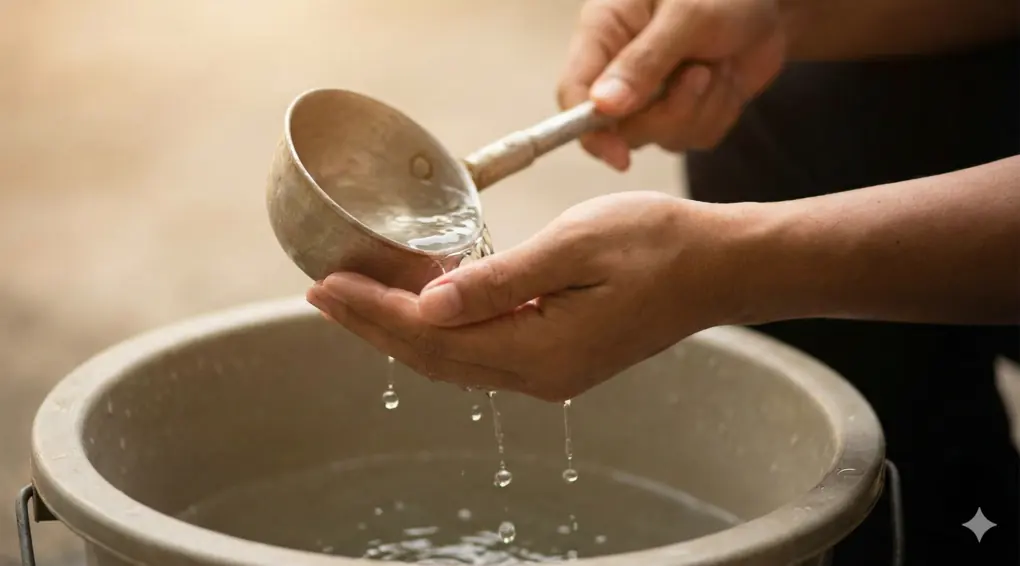
It is a profound sunnah to perform a complete wudu (ablution) on the deceased—exactly like the wudu of a living person—prior to pouring water over the entire body.
- Execute a complete wudu (intention for wudu, washing the face, arms, head, ears, and feet).
- Crucial Detail: When washing the face (specifically the nose and mouth), do not pour water inside; merely wipe them with damp fingers. Tilt the deceased’s head sideways so water does not flow internally.
قوله: (ثم يوضئه كالحي بمضمضة واستنشاق) … (ويميل فيهما رأسه لئلا يدخل الماء باطنه)
“Then perform ablution on him as if he were alive… and tilt his head so water does not enter.”
E. Washing the Hair and Beard
Wash the head and beard utilizing the lather generated from sidr (lote tree) leaves or soap. Gently comb the hair with a wide-toothed comb. If any strands of hair fall out, carefully collect them to be placed inside the shroud (kafan).
(ثم يغسل رأسه ثم لحيته بالسدر) … (ويسرحهما بمشط واسع الأسنان) … (فإن سقطت شعرة ردها)
F. The Pouring Technique (The Three Primary Pours)
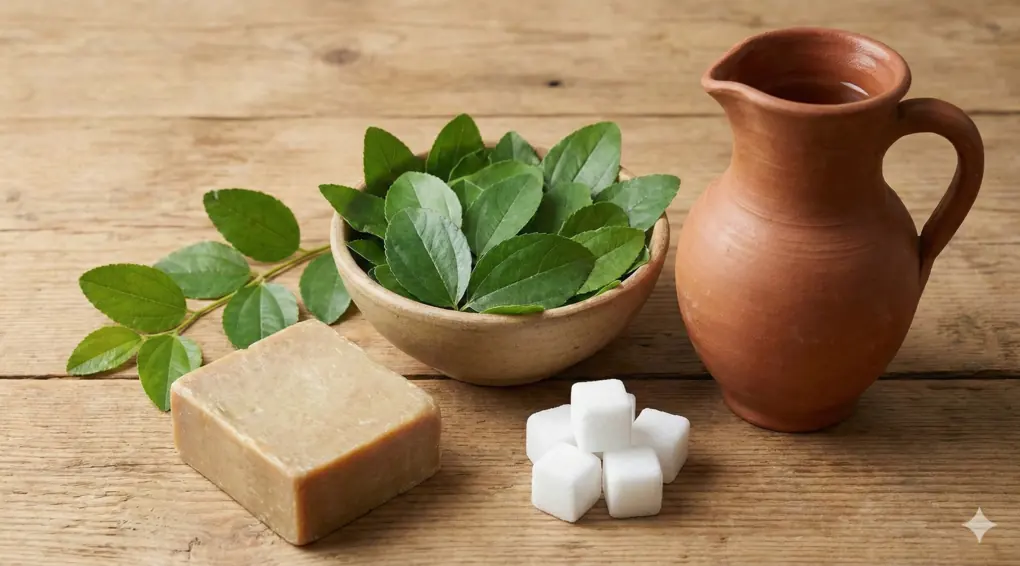
Once the body is entirely free of filth and wudu has been performed, the core washing commences. Remember: It is forbidden (Haram) to flip the body over onto its stomach. Simply tilt it gently to the right and left.
- First Pour (The Right Side): Wash the front right side of the body (from face to foot), then tilt the deceased to their left to wash the back right side.
- Second Pour (The Left Side): Wash the front left side, then tilt the deceased to their right to wash the back left side.
- Third Pour (The Perfection): Pour water comprehensively over the entire body from head to toe. It is a sunnah to repeat this process to achieve an odd number of washes (e.g., 3 times).
قوله: (ثم يغسل شقه الأيمن مما يلي الوجه) … (ثم الأيسر كذلك ثم يحوله لجنبه الأيسر فيغسل شقه الأيمن مما يلي القفا)
“Then wash the right side of the front… then the left side of the front. Then tilt to the left side to wash the right back…”
G. The Application of Camphor & Drying
Camphor: During the final pour, mix in a modest amount of crushed camphor (kafur) to render the body fragrant and cool.
قوله: (ويجعل في كل واحدة من) هذه (الثلاث) … (كافور أو) هو (في الأخيرة آكد)
“And place camphor in every washing (or, more emphasized, in the final washing).”
Drying (Tansyif): Upon completion, it is highly emphasized (obligatory according to some) to meticulously dry the deceased’s body with a towel until completely dry, ensuring the shroud (kafan) does not become damp (which accelerates decomposition).
قوله: (ثم يبالغ في تنشيطه) لئلا تبتل أكفانه فيسرع فساده
“Then be diligent in drying it (with a cloth/towel) so that the shroud does not become wet, thus accelerating decomposition.”
Please note that using cold water and mixing camphor in the final pour is a sunnah. To understand the medical and jurisprudential reasons why warm water should generally be avoided, read our comprehensive explanation in the article: Rulings on using cold water, sidr, and camphor for the deceased.
Summary Table: Minimal Standards vs. Perfection (Asna al-Matalib Version)
| Point | Minimal (Valid) | Perfect (Most Complete) |
| Clothing | Covering navel to knees | Wearing a Thin (Gamis) garment that absorbs water |
| Teeth & Nose | Not obligatory | Cleaned with a finger wrapped in wet cloth |
| Wudu (Ablution) | None | Performed after Istinja’ & before bathing |
| Pouring Order | Directly and evenly | Right Front -> Left Front -> Right Back -> Left Back |
| Water | Absolute Water | Sidr Water (Beginning) & Camphor Water (End) |
| Drying | Not obligatory | Highly Emphasized (Mubalaghah) |
The Intention (Arabic Text & Transliteration)
Although the intention (niyyah) to wash the deceased is not a mandatory pillar (rukun)—meaning it is perfectly valid to wash the body without an intention, as explained previously—it remains highly recommended (sunnah) for the washer to formulate one. Below is the intention articulated silently in the heart by the washer:
1. Intention for Washing a Male:
نَوَيْتُ الْغُسْلَ أَدَاءً عَنْ هَذَا الْمَيِّتِ لِلّٰهِ تَعَالَى
Nawaitu al-ghusla adaa’an ‘an hadhal mayyiti lillahi ta’ala.
(I intend to perform the bath for this deceased male for the sake of Allah the Exalted.)
2. Intention for Washing a Female:
نَوَيْتُ الْغُسْلَ أَدَاءً عَنْ هَذِهِ الْمَيِّتَةِ لِلّٰهِ تَعَالَى
Nawaitul ghusla adaa’an ‘an hadzihil mayyitati lillahi ta’ala. (I intend to perform the bath for this deceased female for the sake of Allah the Exalted.)
A Crucial Note from Asna al-Matalib: If, after the washing is entirely completed, impurity (najis) unexpectedly exits the body again, simply clean the specific impurity. It is absolutely unnecessary to repeat the entire washing process from the beginning.
قوله: (فلو خرج) من الميت (بعد الغسل نجاسة) … (كفاه غسلها) من غير إعادة غسل
“If impurity exits after performing ablution… it is sufficient to only wash the impurity without repeating the ablution.”
Hopefully this guide provides clarity between what is obligatory and what is recommended, so that we can manage the deceased with correct knowledge in accordance with the guidance of the Shafi’i scholars.
Differences in Washing a Male vs. a Female Deceased
Generally, the technical procedure is identical; however, there are distinct details regarding a female corpse that demand attention:
- Braiding the Hair: If the deceased female possesses long hair, it is a sunnah to untie the braids initially while washing. Once the hair is clean and dry, it is re-braided into three distinct sections (two from the sides, one from the crown) and gently placed behind her back.
- The Mahram/Spouse Rules:
- Male Deceased: Must strictly be washed by men. A wife is legally permitted to wash her husband.
- Female Deceased: Must strictly be washed by women. A husband is legally permitted to wash his wife. If there are no women or a husband available, the female deceased is instead given tayammum (dry purification) to fiercely protect her ‘awrah, or washed by a male mahram through a thick layer of cloth.
Summary Table: Minimum vs. Perfect Standards
To facilitate rapid comprehension, review the comparison below:
| Point | Minimum Standard (Valid) | Perfect Standard (Sunnah) |
| Condition | Emergency / Severe Water Shortage / Extreme Haste | Normal / Abundant Water |
| Sequence | Remove Najis -> Pour 1x Evenly | Istinja’ -> Wudu -> Pour 3x (Right then Left) |
| Materials | Absolute (Pure) Water | Pure Water, Sidr Water, Soap, Camphor |
| Hair | Simply ensure water reaches it | Untangled, washed, then braided into three (for women) |
| Wudu | Not mandatory | Highly recommended (Sunnah) |
FAQ: Questions About the Janazah Washing (Funeral Bath)
Must the person who washes the dead body take a major ritual bath (ghusl) afterward?
It is a recommended sunnah (not obligatory) for the individual who finishes washing the deceased to take a major bath (ghusl al-janabah). This serves to thoroughly cleanse oneself from any potential, unnoticed splatters of impurity and completely restores the body’s physical freshness.
What if the deceased is a victim of a severe fire or a catastrophic accident?
If the corpse is mutilated or the skin easily peels off upon contact with water, it MUST NOT be scrubbed or forcefully washed. If utilizing water will inherently damage the corpse, washing is entirely substituted with Tayammum (dry purification using clean earth/dust).
Is it permissible to use warm water?
Yes, it is permissible, particularly if the weather is freezing or to eradicate highly stubborn filth (like heavy grease or dried blood). However, the default ruling heavily favors cold water (normal room temperature) because it effectively tightens the corpse’s flesh, retarding the decomposition process.
Is formulating an intention mandatory when washing the deceased?
No. The primary objective of washing the dead is physical cleanliness, and cleanliness does not depend upon an intention. Furthermore, the legal requirement for an intention applies to a living person bathing themselves, not someone bathing another. The deceased is no longer legally capable of holding an intention, as explicitly clarified by Shaykh Zakariyya al-Ansari above.
What are the primary differences between washing a male and a female?
Technically, the pouring of water is identical. The differences lie in two areas:
Mahram (Who performs the washing): Men are washed by men (or their wives). Women are washed by women (or their husbands). If no one of the same sex or a lawful spouse/mahram is available, the body is given tayammum.
Hair Treatment: Specifically for a female with long hair: after cleaning and combing, it is a sunnah to braid her hair into three distinct sections (right, left, and crown) and place them behind her back. Men’s hair is simply combed neatly without braiding.
Conclusion
Studying how to wash a dead body in Islam is not merely accumulating theoretical knowledge; it is profound mental preparation. One day, our parents, our spouse, or our children might desperately require our hands to purify them for the very last time.
If you wish to learn exactly what steps follow after the body is purified and shrouded, please proceed to our comprehensive master guide: The complete procedures for preparing the deceased (Tajhiz al-Janazah) according to the Sunnah.
May Allah grant us deep understanding and immense ease in tending to our deceased family members in the most perfect manner. Wallahu a’lam bish-shawab.
Reference
al-Anṣārī, Zakariyā. Asnā al-Maṭālib fī Sharḥ Rawḍ al-Ṭālib. With a ḥāshiyah by Aḥmad al-Ramlī. Edited by Muḥammad az-Zuhrī al-Ghamrāwī. Cairo: al-Maṭbaʿah al-Maymānīyah, 1313 H. Reprinted by Dār al-Kitāb al-Islāmī.


